1 hr ago
India Urges Social Platforms to Intensify Monitoring of Misleading Content

India’s technology ministry asked social media companies to watch more carefully for misleading posts.
These could include old videos presented as new, AI-made content, or messages pretending to come from public officials.
The ministry said such posts may confuse people or create problems for public safety.
It did not explain what specific event led it to issue the advisory.
Experts said the notice repeats rules that already exist rather than making a new law.
The notice comes as India is considering changes to its rules for online platforms.
It also follows a dispute involving Meta and a video of Prime Minister Narendra Modi.
Protests were taking place in New Delhi, but the ministry did not link them directly to the advisory.

Meity urged social media platforms to exercise enhanced diligence over false, manipulated or context-free content.
The advisory cited recirculated old images and videos, AI-generated material, impersonation of officials and content that could incite violence.
Meity warned that such material could cause confusion, disturb public order and contribute to law-and-order concerns.
Legal and policy experts said the advisory reiterates existing requirements and does not create a new binding obligation.
The advisory followed draft amendments to intermediary rules and came amid protests in New Delhi and scrutiny of Meta.
- Who
- India’s Ministry of Electronics and Information Technology (Meity) and social media platforms.
- What
- Meity advised platforms to exercise enhanced diligence over misleading, manipulated and out-of-context content.
- Where
- India, amid public protests in New Delhi.
- When
- The advisory was issued on Thursday; the article does not provide a calendar date.
- Why
- Meity said such content could mislead people, create confusion and affect public order; it did not state what prompted the advisory.
Government’s rationale
Experts’ and industry concerns
Need for closer content monitoring
Government’s rationale
Meity said misleading or manipulated content can confuse people, disturb public order and contribute to law-and-order concerns.
Experts’ and industry concerns
The article reports that industry observers view the advisory as another sign of growing government scrutiny of social media platforms.
Whether the advisory creates new duties
Government’s rationale
Meity urged platforms to exercise enhanced diligence and described risks posed by a broad range of content.
Experts’ and industry concerns
Legal and policy experts said the advisory reiterates existing intermediary requirements and does not create a separate binding obligation.
Key facts
- Issuing authority
- Ministry of Electronics and Information Technology (Meity)
- Advisory timing
- Issued on Thursday; no calendar date specified
- Content flagged
- False, misleading, manipulated or out-of-context material
- Examples cited
- Old images or videos recirculated as current, AI-generated content, impersonation of public officials and material that could incite violence
- Stated risks
- Public confusion, apprehension, disturbance of public order and law-and-order concerns
- Legal status
- The article says the advisory was a statutory caution, not a binding law or a separate notice against all intermediaries
- Related draft amendments
- Meity published draft amendments to the Intermediary Rules on 30 March; they had not yet been notified
- Recent Meta dispute
- A video featuring Prime Minister Narendra Modi was removed from Facebook for four hours at the end of July, according to the article
Quotes
Meity advisory
An advisory issued by India’s Ministry of Electronics and Information Technology.
“Certain information, including false, misleading, manipulated or out-of-context content, is being circulated through various social media platforms in relation to ongoing public events and developments. Such content, particularly when presented as current or authentic information, has the potential to cause public confusion, create apprehension, disturb public order and social tranquillity, and contribute to law-and-order concerns.”
 livemint.com
“This is not restricted to merely synthetically generated information (AI content), but extends to a wider set of content within IT rules.”
livemint.com
Sources
Related news
India Restricts Political Cartoonist Satish Acharya’s Instagram Account

Meta Admits Mistake, Agrees to Report Child Abuse in India
Meta Agrees to Report Child Safety Cases in India
Meta Restricts Viral AI Video of Kerala Chief Minister Dancing
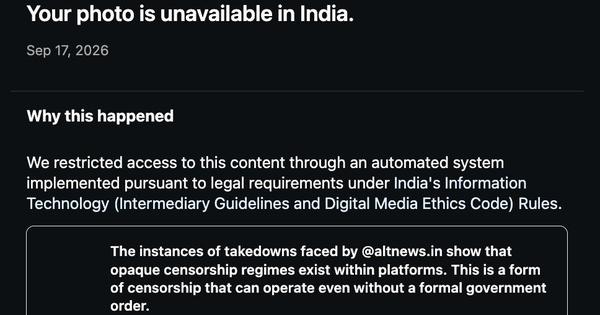
Instagram Restricts Digital Rights Group Post Over Alt News Censorship

X Accuses Centre of Backdoor Sahyog Portal Push

Cockroach Movement Says India Detained Activists Before Delhi Rally
Revanth Reddy Demands BJP Sack Chief Election Commissioner

Chhattisgarh Telibandha Plan Sparks BJP-Congress Dispute Over Landmark

Mumbai One App Marks First Year With 11 Operators