

4 hrs ago
India Proposes Expanding Services Output Index Coverage
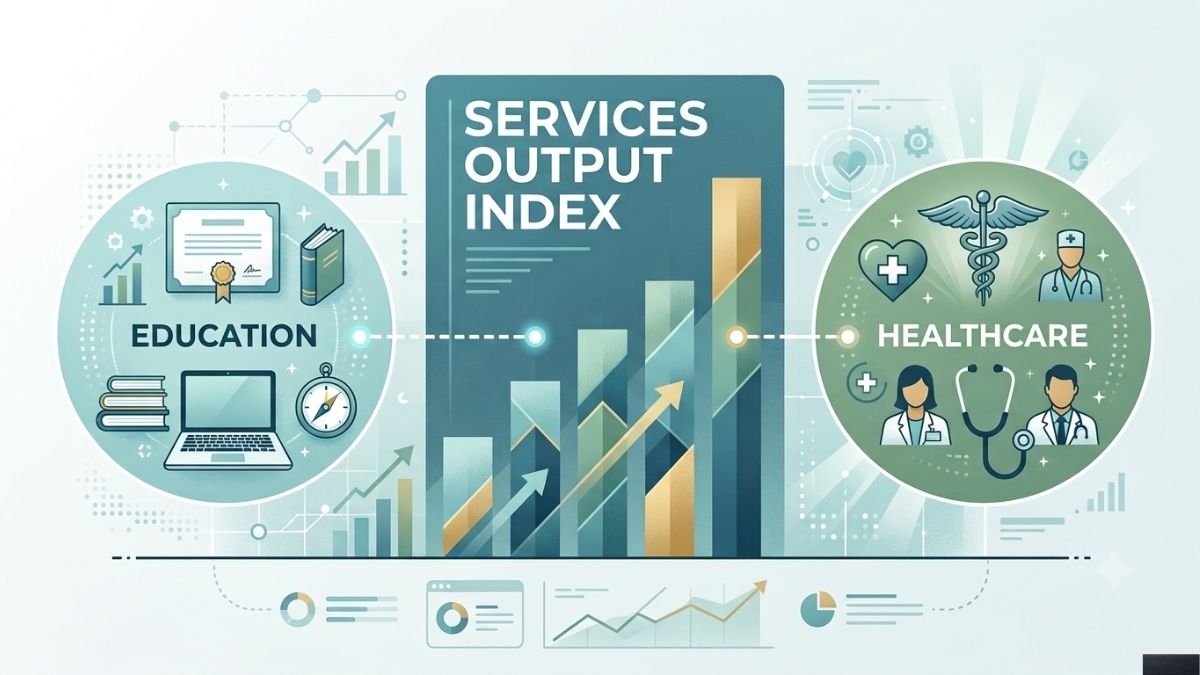
India is working on a monthly measure of how much its service industries produce.
The measure already covers 19 kinds of services.
The statistics ministry wants to add education, healthcare, and government administration and defence.
These areas make up nearly one-fifth of the services economy.
Adding them could bring the measure’s coverage to about 80%.
Some of these services do not have ordinary sales prices that can be counted.
So the ministry proposes using payment records and government spending data to estimate their output.
The index is being tested, and the ministry has not yet published an overall growth rate for it.

MoSPI has proposed adding education, healthcare, and public administration and defence to the Index of Services Production.
The three sectors represent nearly 21% of India’s services gross value added; their inclusion could raise the index’s coverage to around 80%.
The trial index began in July with 2024-25 as its base year and currently covers 19 service sub-sectors, representing nearly 60% of services GVA.
MoSPI proposes using UPI merchant-category transactions for private education and healthcare, and government expenditure records for public services.
Economists estimated output across the 19 currently covered services grew 13.5% in July, compared with 13.2% in June.
- Who
- The Ministry of Statistics and Programme Implementation (MoSPI).
- What
- Proposed adding education, healthcare, and public administration and defence to the Index of Services Production.
- Where
- India.
- When
- The index was introduced on a trial basis in July; the proposal was reported without a specific date.
- Why
- To measure more of the services sector, including activities that are difficult to track using conventional turnover-based methods.
Measurement challenge
Proposed approach
Measuring non-market services
Measurement challenge
Education, health, and public administration and defence do not readily lend themselves to conventional turnover-based measurement; public administration and defence generally lack economically meaningful transaction prices.
Proposed approach
MoSPI proposes combining UPI transaction data, administrative expenditure data, and appropriate price deflators to estimate output.
Key facts
- Index
- Index of Services Production (ISP), introduced on a trial basis.
- Base year
- 2024-25.
- Current coverage
- 19 broad service sub-sectors, representing nearly 60% of services-sector GVA.
- Proposed additions
- Education, healthcare, and public administration and defence.
- Potential coverage
- Around 80% of services-sector GVA after the proposed additions.
- Proposed private-sector measure
- UPI Merchant Category Code transaction data for private education and healthcare.
- Proposed public-sector measures
- Central government PFMS ledger data and state accounts reports available through the CAG; PFMS expenditure data is also proposed for public education and health.
- Estimated growth
- Economists estimated output of the 19 covered services grew 13.5% in July, up from 13.2% in June; MoSPI has not published an overall ISP growth rate.
Quotes
Ministry of Statistics and Programme Implementation
The Indian government ministry responsible for statistics and programme implementation.
“It is to be noted that major service activities such as Education, Health and Public Administration & Defence do not lend themselves readily to conventional turnover-based measurement. The proposed framework addresses this problem by combining administrative expenditure data, UPI transaction data and appropriate price deflators.”
 financialexpress.com
Sources
Related news
India’s Services Index Shows Broad Growth Across Sectors

India’s New GDP Series Broadens Measurement With Solar, Gig Work
India Services PMI Reaches Three-Month High, Quarterly Growth Weakens

Ayush services support 1.76 million livelihoods, report says
MoSPI Defends Lower GDP Estimates With Better Informal-Sector Data
Modi’s 25-Year Public Journey Showcases Five Global-Scale Initiatives
Centre Urges States to Increase Capital Spending with Loans
NMMSS 2026-27 Application Deadline Extended to September 30
India Expands Digital Fertilizer Tracking for Subsidy Oversight

Uttar Pradesh Reopens Scholarship Portal for 316,057 Students
