

Archive · 24 Nov 2025
Floating Solar Can Boost India's Green Transition
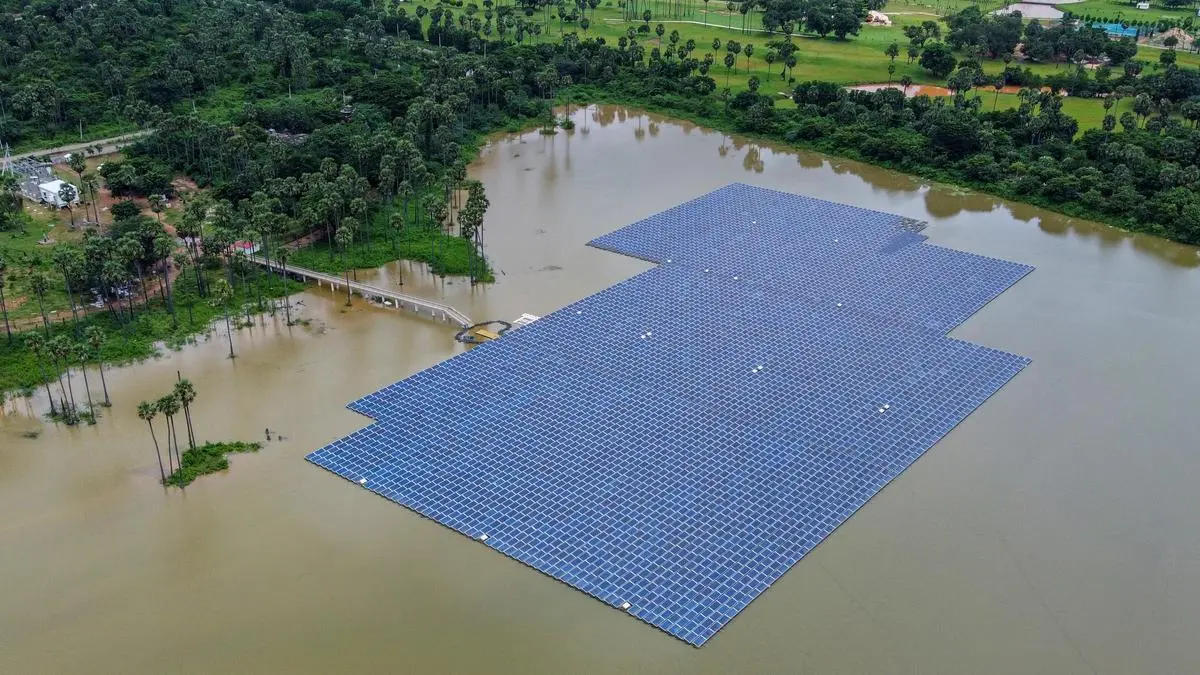
India wants to use more clean energy by 2030.
One way is to put solar panels on water, called floating solar.
This can make more energy without using land.
It also works better because water keeps the panels cool.
But it costs more to set up.
Some places in India, like Maharashtra and Karnataka, are good for this.
The government might need to help pay for it so it's cheaper.
People also need to make sure it doesn't hurt fish and other animals in the water.

India aims to generate 500 GW of non-fossil fuel energy by 2030, with 280 GW from solar.
Floating solar PV (FPV) can generate 227 GW using just 10% of India's water sources.
FPVs offer higher efficiency and reduced evaporation but have higher initial costs.
Maharashtra and Odisha have the most suitable reservoirs for FPV deployment.
Policy interventions like interest rate subsidies or capex subsidies could make FPVs more competitive.
- Who
- India
- What
- Floating solar photovoltaic (FPV) technology
- When
- Target set for 2030
- Where
- India, with a focus on Maharashtra and Odisha
- Why
- To meet renewable energy targets and address land scarcity in urban areas
- Target
- 500 GW of non-fossil fuel energy capacity by 2030, including 280 GW of solar energy
- Potential
- 10% of India's water sources could generate 227 GW of FPV power
- Advantages
- Higher efficiency, reduced evaporation, and natural cooling
- Challenges
- Higher initial costs, lack of standard components, and potential impact on biodiversity
- Ideal Locations
- Maharashtra and Odisha have the highest number of suitable reservoirs
- Most Suitable Reservoir
- Almatti reservoir in Karnataka
- LCOE Range
- ₹3.16 to ₹3.80 per kWh for select reservoirs
- National Average Electricity Tariff
- ₹6.29 per kWh