

Archive · 22 Jul 2026
BMC Considers Octroi Naka Plots for PoP Ganpati Idol Recycling
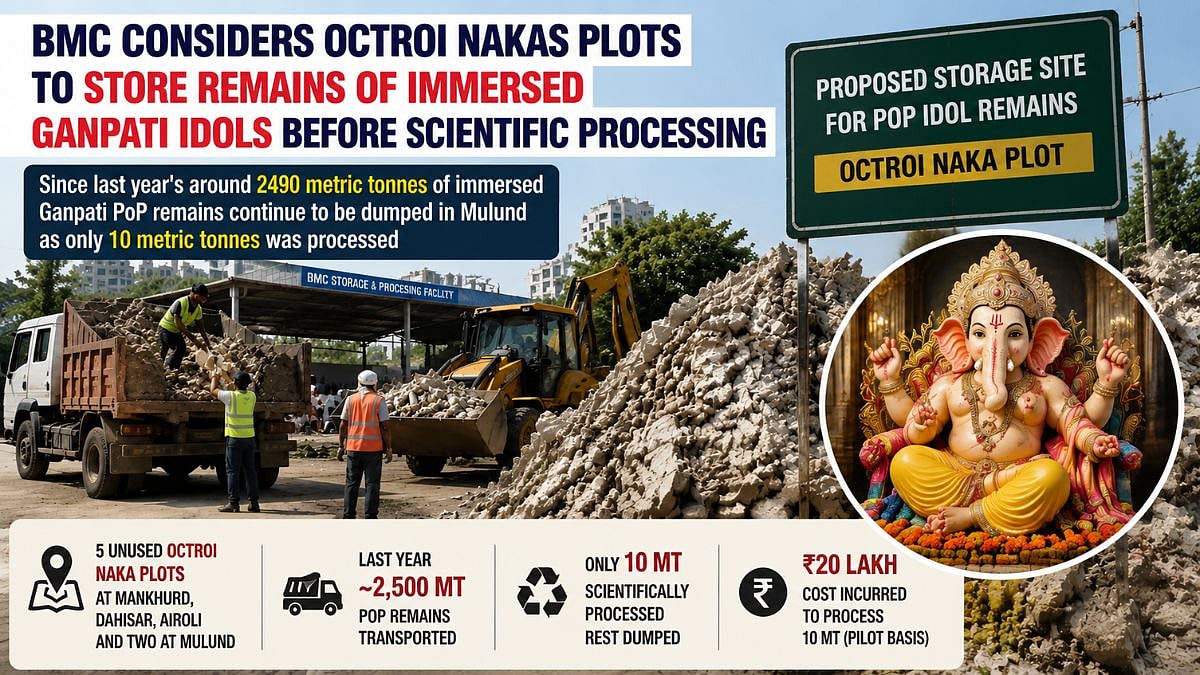
The BMC in Mumbai is thinking about using old Octroi Naka plots to store the remains of Plaster of Paris (PoP) Ganesh idols after they are immersed in water.
Last year, they had trouble storing these remains and are now looking for better places.
They are also planning to recycle these remains scientifically.
However, last year they only recycled a small amount because it was very expensive.
The BMC will soon invite companies to help with the recycling.
There are two main methods for recycling: one uses chemicals, and the other uses heat.
Meanwhile, there is a court case about whether PoP idols should be allowed to be immersed in natural water bodies.
Some people want to stop this practice, while the government wants to continue it and try recycling.

BMC considers using Octroi Naka plots to store PoP Ganesh idol remains.
Last year, 2,500 metric tonnes of PoP remains were transported, but only 10 metric tonnes were recycled.
Recycling 10 metric tonnes cost Rs 20 lakh, making it an expensive process.
BMC plans to float tenders for scientific recycling of PoP remains.
Two recommended recycling methods: chemical disintegration and calcination process.
- Who
- BMC, Environmental Activists, State Government
- What
- Consideration of Octroi Naka plots for storing and recycling PoP Ganpati idol remains
- When
- July 21, 2026
- Where
- Mumbai, India
- Why
- To facilitate the storage and scientific recycling of PoP remains from immersed Ganesh idols
Environmental Activists
State Government
Immersion of PoP Idols
Environmental Activists
Strict implementation of CPCB guidelines to prohibit immersion of PoP idols in natural water bodies.
State Government
Seeks court's permission to continue the practice, experimenting with pilot projects for collection and recycling.
- Location of Octroi Naka Plots
- Mankhurd, Dahisar, Airoli, and two in Mulund
- Current Storage Location
- Mulund plot, formerly a dumping ground
- PoP Remains Transported Last Year
- 2,500 metric tonnes
- PoP Remains Processed Last Year
- 10 metric tonnes
- Cost of Processing 10 Metric Tonnes
- Rs 20 lakh
- Recommended Recycling Methods
- Chemical disintegration and calcination (wet and dry) process
- Expert Committee Recommendation
- Biological disintegration of PoP waste is not technically feasible