

Archive · 2 Jul 2025
Scientists Witness Rare 'Double Detonation' of Star
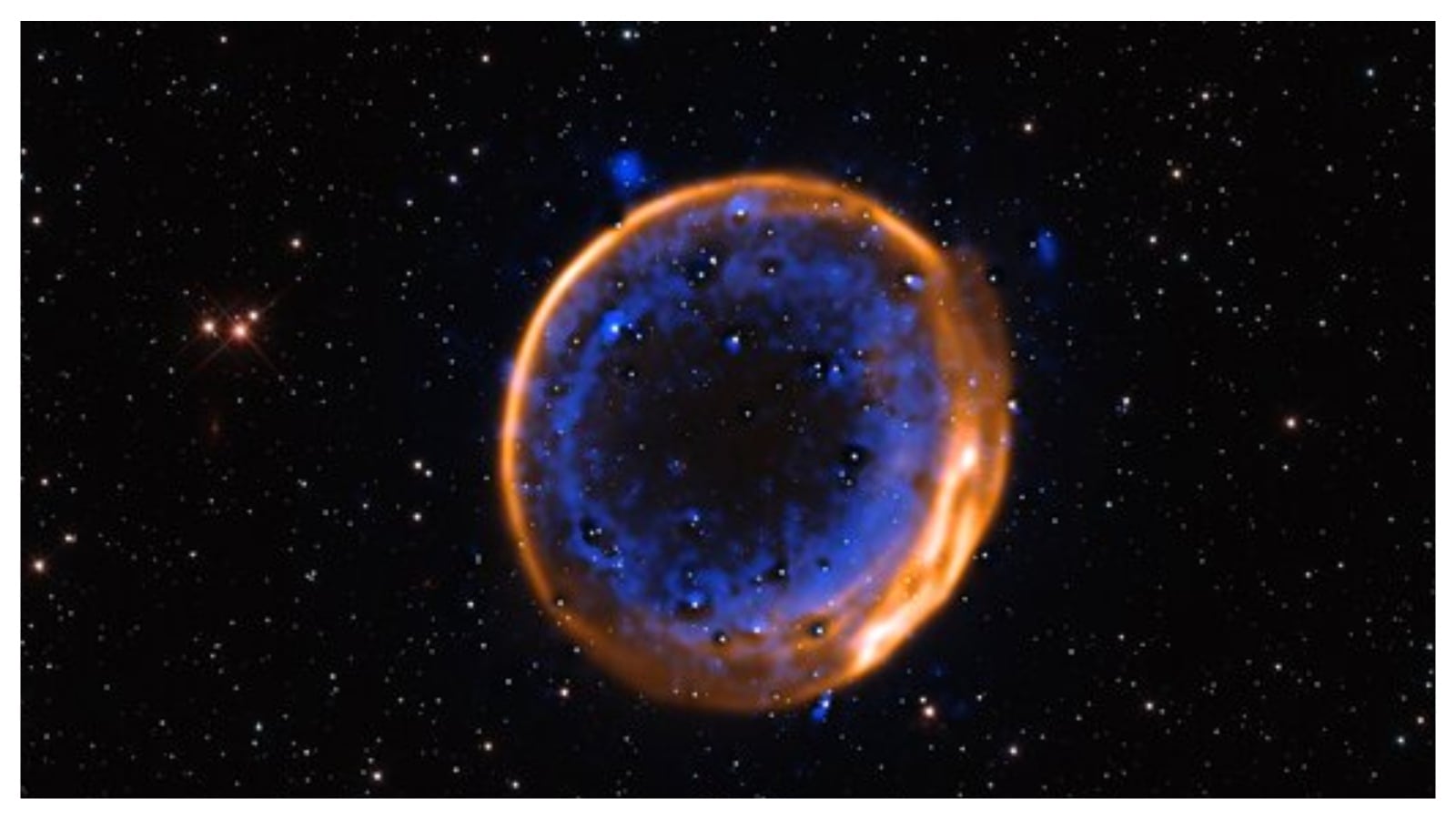
Scientists have found evidence of a star dying twice!
They looked at the remains of a supernova, called SNR 0509-67.5, and saw signs of two explosions.
This happens when a white dwarf star, which is like a dead star, steals gas from a nearby star.
This stolen gas, made of helium, then blows up.
The first explosion sends a shockwave to the star's core, leading to another bigger explosion.
This changes what we thought about how stars die and helps scientists measure distances in space.

Scientists observed a 'double detonation' in the supernova remnant SNR 0509-67.5.
This suggests some stars can explode twice, challenging previous beliefs.
The double detonation process involves a white dwarf star drawing material and igniting helium.
The first explosion sends a shockwave to the core causing a second detonation.
The discovery provides insights into Type Ia supernovas and cosmic distances.
- Who
- Scientists from the European Space Observatory (ESO) made the discovery.
- What
- Scientists observed a 'double detonation' of a star, implying it died twice.
- When
- The supernova remnant SNR 0509-67.5 is believed to have formed more than 300 years ago.
- Where
- The observation was made of the supernova remnant SNR 0509-67.5, located more than 160,000 light-years away.
- Why
- To better understand Type Ia supernovas and the lifecycle of stars.
- Supernova Remnant
- SNR 0509-67.5
- Distance
- More than 160,000 light-years
- Event Time
- More than 300 years ago
- Telescope Used
- Very Large Telescope (VLT)
- Instrument Used
- Multi Unit Spectroscopic Explorer (MUSE)
- Star Type
- White Dwarf
- Supernova Type
- Type Ia