

Archive · 5 Aug 2026
Opposition demands J&K statehood as Modi hails Article 370 anniversary
Jammu and Kashmir is a place in India.
A long time ago, it had a special rule called Article 370.
This rule gave people there some special rights.
Seven years ago, the Indian government removed that rule.
It also split Jammu and Kashmir into two parts.
Some leaders think this was a good change.
They say it brought peace, new schools, and better hospitals.
Other leaders think it was unfair.
They say people lost their rights and promises were broken.
On the anniversary, people from both sides gathered to share their views.

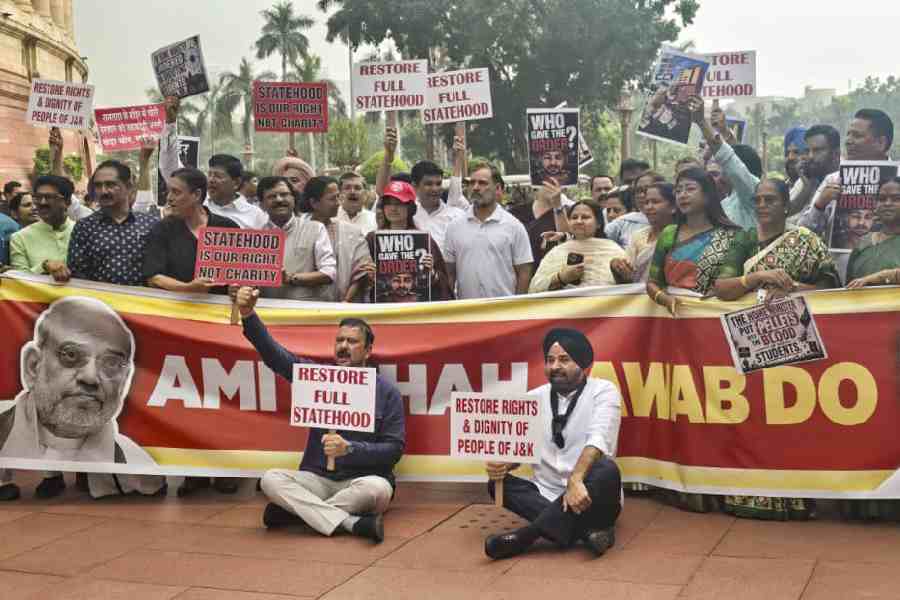
Congress leaders Rahul Gandhi, Priyanka Gandhi Vadra, and Mallikarjun Kharge led an Opposition protest at Parliament demanding the restoration of Jammu and Kashmir statehood.
Wednesday marked seven years since the abrogation of Article 370 and Article 35A, which ended Jammu and Kashmir's special status and reorganized the state into two union territories: Jammu and Kashmir, and Ladakh.
Prime Minister Narendra Modi hailed the August 5, 2019 decision as a 'decisive new chapter,' citing expanded infrastructure and more opportunities in education, healthcare, entrepreneurship, and sports.
Jammu and Kashmir Chief Minister Omar Abdullah and other critics said promises such as restoration of statehood remain unfulfilled, with some calling the move 'a brutal coup' and a 'black day.'
The BJP said the decision, taken under Modi and Home Minister Amit Shah, strengthened India's unity and integrity, and party workers held a Tiranga rally in Anantnag.
Opposition MPs also demanded a statement from Amit Shah on alleged police excesses against students and a discussion on the alleged misappropriation of Ram Temple donations.
- Who
- Opposition leaders Rahul Gandhi, Priyanka Gandhi Vadra, and Mallikarjun Kharge, alongside Prime Minister Narendra Modi, Defence Minister Rajnath Singh, and Jammu and Kashmir Chief Minister Omar Abdullah.
- What
- The seventh anniversary of the abrogation of Article 370 and Article 35A, marked by an Opposition protest demanding J&K statehood and by the BJP celebrating the decision.
- When
- Wednesday, seven years after August 5, 2019.
- Where
- Parliament in India; a Tiranga rally in Anantnag, Jammu and Kashmir; the event concerns the union territories of Jammu and Kashmir, and Ladakh.
- Why
- The Opposition says the promise to restore statehood has not been fulfilled and rights were taken away, while the government says the decision integrated the region and empowered its people.
Opposition and critics
Government and BJP
Restoration of statehood
Opposition and critics
The promise to restore Jammu and Kashmir's statehood remains unfulfilled after seven years, and people who lost their rights have not reconciled to the current circumstances.
Government and BJP
The decision was a milestone in the region's full constitutional and developmental integration with the rest of India, marking a new era of unity, equality, and development.
Impact of the abrogation
Opposition and critics
Critics describe the move as 'a brutal coup' and a 'black day' that turned Jammu and Kashmir into a jail, with a continuing crackdown on political activity, dissent, and press freedom.
Government and BJP
The decision brought peace, progress, and equal opportunity, empowering women and marginalized communities who had been denied basic constitutional rights for decades.
Historical promises and identity
Opposition and critics
Special status was a promise made to Jammu and Kashmir at the time of accession, and its removal threatens the region's rights and identity.
Government and BJP
The decision ended the system of 'two constitutions and two flags' and strengthened India's unity and integrity.
- Event
- Seventh anniversary of Article 370 abrogation
- Abrogation date
- August 5, 2019
- Legal changes
- Abrogation of Article 370 and Article 35A
- Territorial outcome
- Jammu and Kashmir split into two union territories: Jammu and Kashmir, and Ladakh
- Opposition demand
- Restoration of Jammu and Kashmir statehood
- Government position
- A new chapter of unity, equality, peace, progress, and development
- Key criticism
- Sajad Gani Lone called it 'a brutal coup'; PDP called it a 'black day'; CPIM called it a 'systematic assault'
- Other Opposition demands
- Amit Shah statement on alleged police excesses against students; discussion on alleged misappropriation of Ram Temple donations