

8 months ago
Seema Kohli's Artistic Journey Explored in Delhi Exhibitions
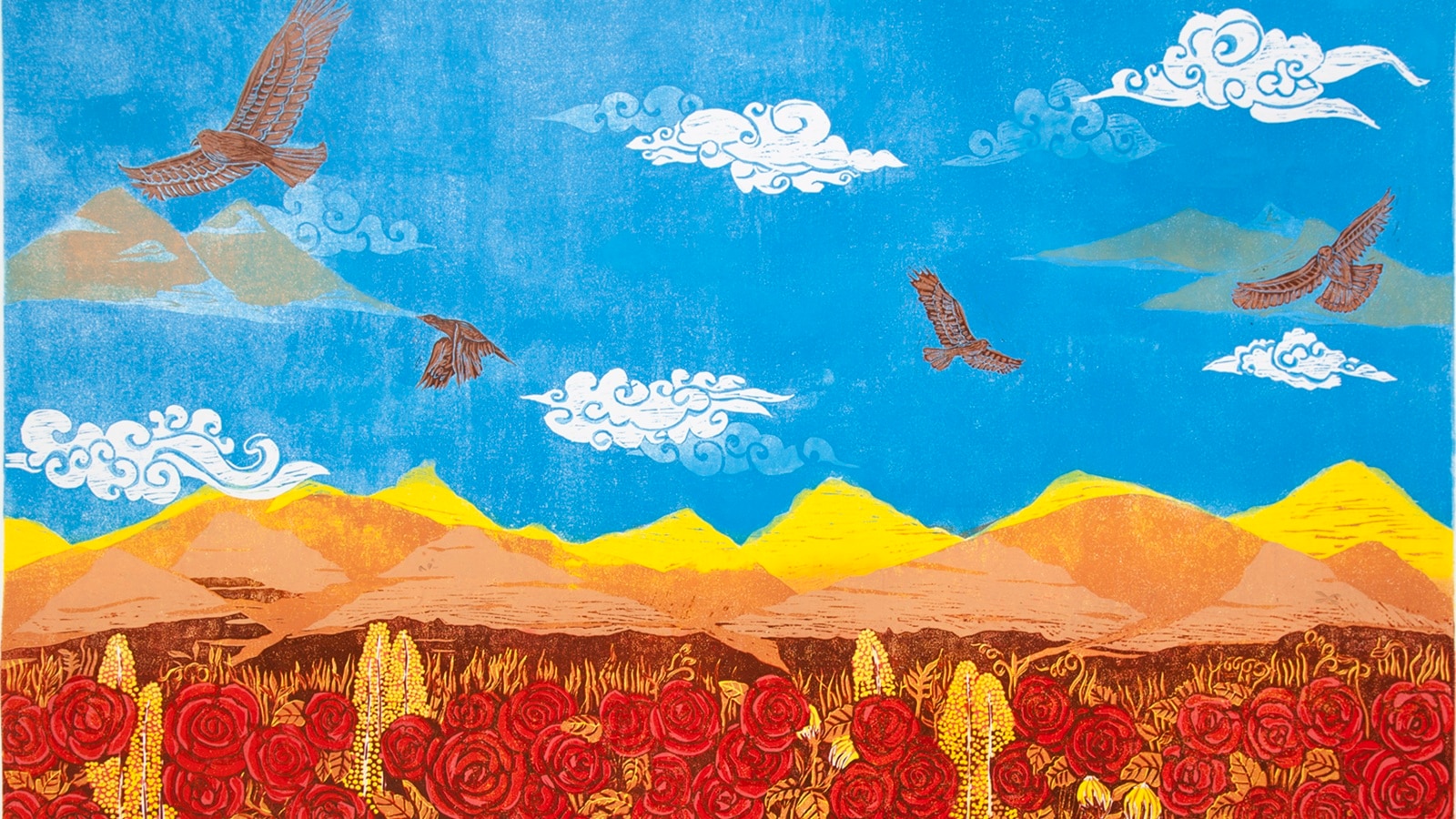
Seema Kohli, a famous artist, is showing her art in two big exhibitions in Delhi.
One is called 'Bodies of Sky, Bodies of Earth' and talks about how our bodies hold stories and memories.
The other, 'With Her Hair Running Wild,' is about wild goddesses and passionate gods.
Seema has been making art for over 40 years and her work is inspired by her father's stories, her family's history, and different spiritual and philosophical ideas.
She uses many different materials like paint, textiles, and photographs to tell her stories.
Her art is a way for her to connect with herself, her family, and the world around her.

Two concurrent solo exhibitions by Seema Kohli at Triveni Kala Sangam in Delhi, presented by Gallerie Nvya.
Exhibitions explore themes of the body as an archive and stories of undomesticated goddesses and gods.
Seema Kohli's work is influenced by ancient metaphysical texts, Indian mythology, and personal family history.
Her artistic journey began in childhood, inspired by her parents introducing her to art and color.
Exhibitions feature over 40 years of her art practice, including multimedia components and personal narratives.
- Who
- Contemporary artist Seema Kohli
- What
- Two solo exhibitions showcasing her artistic journey over 40 years
- Where
- Triveni Kala Sangam in Delhi
- When
- Current exhibitions (specific dates not mentioned)
- Why
- To explore themes of the body as an archive, undomesticated goddesses, and personal and collective histories
Key facts
- Artist
- Seema Kohli
- Exhibition Venues
- Triveni Kala Sangam, Delhi
- Exhibition Organizer
- Gallerie Nvya
- Exhibition Themes
- Bodies of Sky, Bodies of Earth and With Her Hair Running Wild
- Artistic Mediums
- Acrylic, watercolors, lithographs, multimedia components
- Influences
- Bhakti and Sufi poetry, Tantra, Samkhya, Yoga, Kashmir Shaivism, Vedanta, Western philosophy
- Personal Inspirations
- Father's autobiography, ancestral memories, migration, and loss
Quotes

Seema Kohli
Contemporary artist Seema Kohli
“Art, to me, is akin to my life. It is not separated as ‘work’. In every moment, it is a conversation, an internal journey or a solitary path animated by a living confluence of spiritual and intellectual traditions. I am inspired by mystic poetry from Bhakti and Sufi saints such as Kabir, Bulleh Shah, Baba Farid and Lal Ded (all voices that celebrate the body as altar and the soul as journey), by the philosophies of Tantra, Samkhya and Yoga, and especially by Shakti-centred systems like Kashmir Shaivism and the Vijñāna Bhairava Tantra. Each of these traditions deeply informs my sense of ritual, embodiment and energy flow in creation. I have been raised in a traditional Adwaita household, where Vedanta was a way of life. But I was lucky, for I was introduced to many faiths and philosophies, including Sikhism, Buddhism and Sufism. I studied Western philosophical thought during college, where I was exposed to thinkers such as Descartes, Hume, Jung and Plato. They, too, informed my exploration of consciousness, perception and mythic identity. Together, all these threads — poetry, Tantra, philosophy — intertwine in my visual language, shaping how I gesture with colour, form and ritualistic process.”
 indianexpress.com
“A lot of my work naturally leans towards the transformational energies of the feminine. What really attracts me to the concerned subject matter is the effortless and unconditional collaborations. In fact, it is the vast, deviating variant of the energy forms of the feminine that I am constantly exploring through my practice… Through a critical reading of ancient metaphysical texts such as the Garbha Upanishad, I became conscious of the inconsistencies and ambivalence delineating the gendered ascriptions in these accounts. For instance, the term hiranyagarbha is extended as an appellation to Surya or Brahma, both traditionally gendered as male. This, together with concepts such as the Ardhanarishwar, the vast assembly of ambiguous beings in the extensive Hindu pantheon such as yakshas and yakshinis, my kamadhenu as well as the numerous narratives in Indian mythology involving, transgenders and transvestites, kings that become pregnant or spend their time in exile impersonating eunuchs, and gods who dress up as gopis (rural milkmaids) to gain access to a dance, or ones whose gender fluctuates with the lunar circuit, contributed to my understanding of gender as a spectrum.”
indianexpress.com
Sources
Related news

Art Exhibitions and Design Showcase Headline This Week’s Cultural Calendar

Paropakar 2026 Art Exhibition Funds Education for Underprivileged Children

Paropakar 2026 Art Sale in Jubilee Hills to Fund Education

Art Exhibitions and Cultural Events in India
