Archive · 9 Nov 2025
Interstellar Comet 3I/ATLAS Sparks Debate Over Missing Tail and Origin
Imagine a cosmic snowball, called a comet, that came from another star system, named 3I/ATLAS.
Usually, when a comet gets close to the Sun, its ice turns into gas and dust, creating a long, glowing tail.
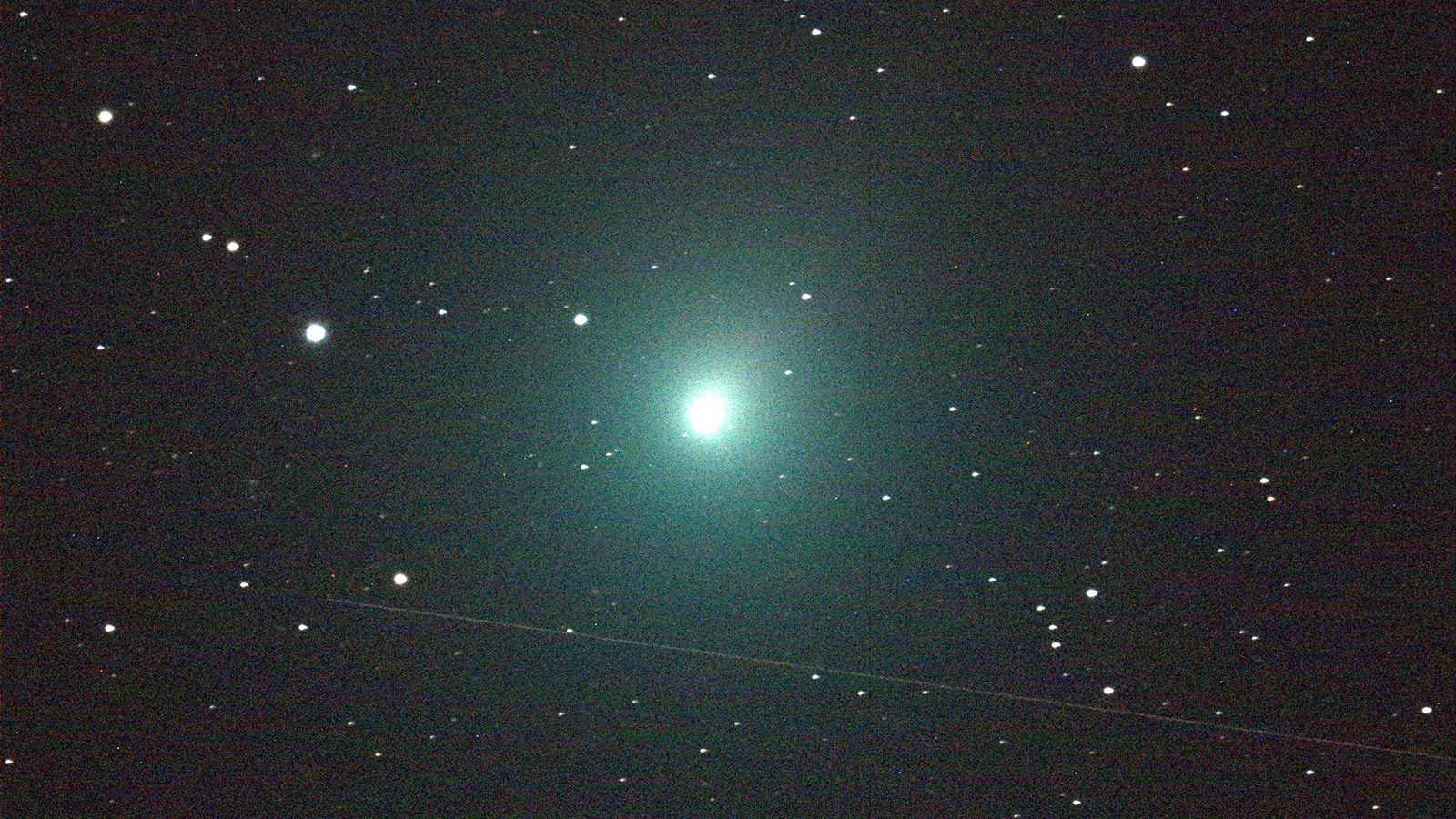
But pictures taken recently show 3I/ATLAS looking like it has no tail at all, even after it got closest to the Sun!
This has scientists scratching their heads.
Some think maybe we just can't see the tail because of how it's facing us, or that its outer layer is acting strangely.
However, one scientist, Avi Loeb, thinks it's so unusual that it might even be a spaceship from outer space!
The comet has also gotten much brighter and turned green, which scientists say is likely because of special carbon molecules that glow when sunlight hits them.
Scientists will keep watching it, especially as it flies by Jupiter, to learn more about this mysterious visitor from another part of the galaxy.

Interstellar object 3I/ATLAS was observed without a visible tail after passing perihelion, contradicting typical cometary behavior.
The object brightened fivefold and turned green, indicating the potential emission of diatomic carbon.
The absence of a tail has reignited debate, with some scientists suggesting it could be an alien spacecraft, while others propose it's a comet with an unusual composition or orientation.
Previous observations showed a sunward jet (anti-tail) in July and August, described as not being an optical illusion.
NASA and ESA will continue monitoring 3I/ATLAS as it approaches Jupiter in March 2026.
- Who
- Scientists, including Avi Loeb, and observatories like R Naves Observatory
- What
- Observed interstellar object 3I/ATLAS appearing without a tail after perihelion, while also brightening and exhibiting a green glow, sparking debate about its origin and composition.
- When
- New observations on November 5, with previous observations in July and August. Upcoming observation near Jupiter on March 16, 2026.
- Where
- Observations made from Earth, including by the R Naves Observatory in Spain. The object is an interstellar object passing through our solar system.
- Why
- To study the unusual behavior and composition of 3I/ATLAS, which challenges typical cometary models and fuels speculation about its nature.
Alien Spacecraft Hypothesis
Cometary Explanations
Tail Appearance
Alien Spacecraft Hypothesis
The absence of a visible tail, despite perihelion passage and expected outgassing, suggests it might not be a natural comet and could potentially be an alien spacecraft.
Cometary Explanations
The tail may be oriented away from Earth, or it could be an optical illusion. Other possibilities include an irradiated crust altering its outgassing pattern, or the tail is not as massive as expected for a typical comet of its size.
Observed Behavior
Alien Spacecraft Hypothesis
Unusual motion and brightening, coupled with the lack of a tail, support the idea of an artificial object.
Cometary Explanations
The brightening and green hue can be attributed to diatomic carbon emission from hydrocarbons broken down by solar radiation. The previous sunward jet (anti-tail) observed might not be a typical phenomenon but is still a natural cometary behavior.
- Object
- Interstellar Object 3I/ATLAS
- Observation Date (Spain)
- November 5
- Perihelion Passage
- Recent (prior to November 5)
- Observed Features
- Apparent lack of tail, fivefold brightening after perihelion, green glow (indicating diatomic carbon)
- Previous Observation (July-August)
- Displayed a sunward jet (anti-tail)
- Prominent Advocate for Alien Origin
- Avi Loeb
- Upcoming Observation
- Approaching Jupiter on March 16, 2026
Sources
New observations of comet 3I/ATLAS reveal glowing diatomic carbon and a ‘missing’ tail
Comet 3I/ATLAS lights up the sky with carbon glow, and a ‘missing’ tail
Why Interstellar Comet 3I/ATLAS Is 'Missing' Its Tail — Here's What We Know