

Archive · 12 Nov 2025
Mysterious Peruvian Holes Explained as Ancient Marketplace and Accounting System
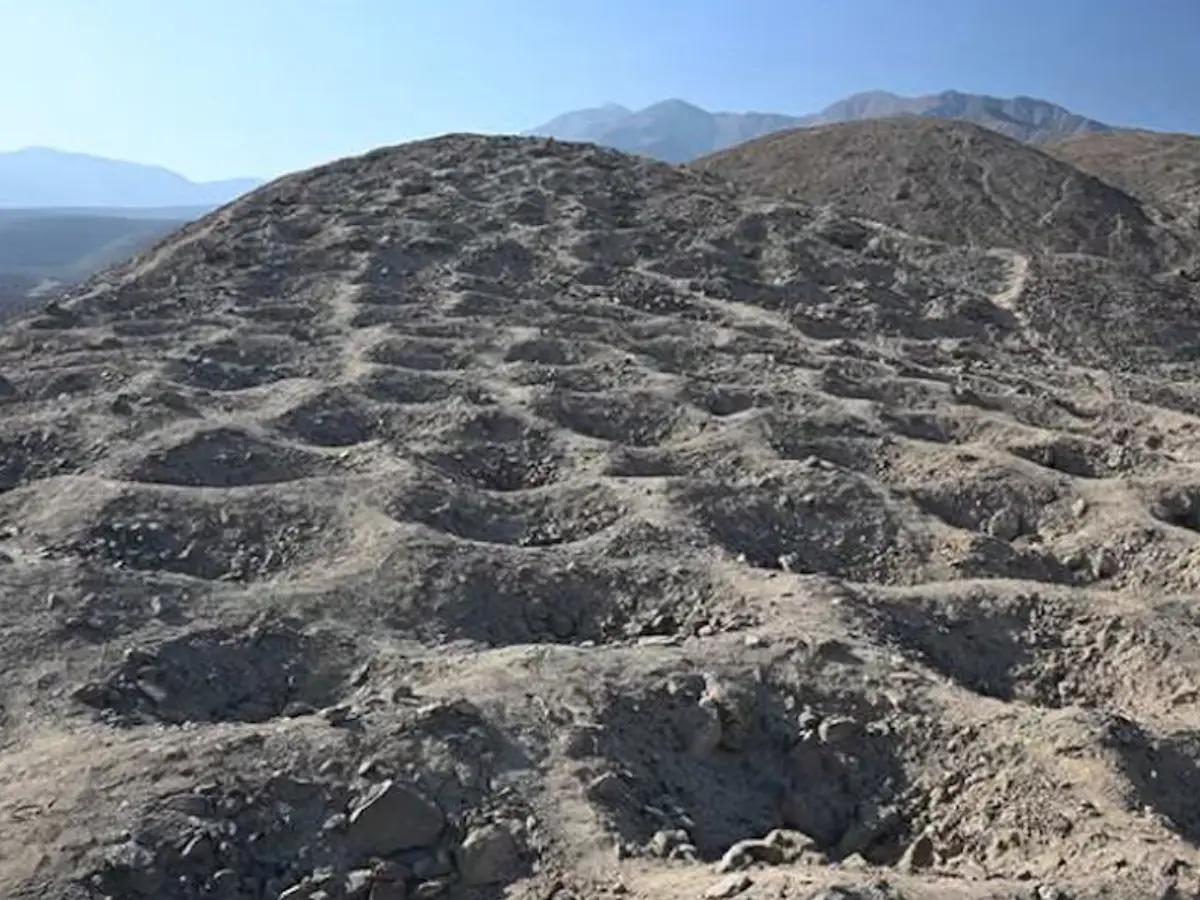
Imagine a big mountain in Peru with almost 5,200 holes dug into it.
For a very long time, people didn't know what they were for, thinking they might be old, empty graves.
But scientists looked very closely at the dirt inside the holes.
They found corn and plants that people used to make things like baskets.
This made them think that maybe it wasn't for graves at all!
Instead, they believe it was a special place, like a giant outdoor market, where people traded food and other items a long, long time ago.
It might have also been used later to keep track of things people owed to others, like a very old way of counting.
So, instead of mysterious graves, these holes were part of an ancient community hub.

Nearly 5,200 mysterious holes on Monte Sierpe in southern Peru have been a puzzle for about 100 years.
Previous theories suggested the holes were unused pre-Inca graves.
A new study in the journal Antiquity reveals the holes were likely part of a pre-Inca marketplace.
Microbotanical analysis found corn and wild plants, suggesting storage and trade of goods.
Researchers also propose the site may have later functioned as an accounting system for tribute.
- Who
- Researchers, lead author Jacob Bongers, and ancient peoples of Peru
- What
- Discovery that approximately 5,200 holes are likely remnants of a pre-Inca marketplace and an accounting system.
- When
- Nearly 100 years of mystery, with new study published recently.
- Where
- Monte Sierpe (Serpent Mountain), southern Peru’s Andes.
- Why
- The holes likely served as a marketplace for exchange of goods and later as a system to extract tribute.
Traditional Theories
New Study Findings
Purpose of the Holes
Traditional Theories
Believed to be unused pre-Inca civilization graves.
New Study Findings
Interpreted as part of a pre-Inca marketplace and later an accounting system for tribute extraction.
Contents of the Holes
Traditional Theories
Undetermined (graves were believed to be empty).
New Study Findings
Contained corn and ancient wild plants, likely for storage, suggesting trade of local goods.
- Location
- Monte Sierpe (Serpent Mountain), southern Peru’s Andes
- Number of Holes
- Approximately 5,200
- Hole Dimensions
- 3 to 6 feet wide, up to 3 feet deep
- Discovery Mention
- First came to light after aerial photograph in National Geographic, 1933
- Site Name
- Band of Holes
- Study Publication
- Journal Antiquity