

Archive · 30 Oct 2025
South Africans Increasingly Dissatisfied Amidst Declining Living Standards
Imagine South Africa is like a house that used to be in a certain state of disrepair, but many people thought things would get better after a big change.
However, for a long time, the money the country makes per person hasn't grown, and many people, especially young ones, can't find jobs because they don't have any work experience.
This creates a cycle where it's hard to get a job without experience, and hard to get experience without a job.
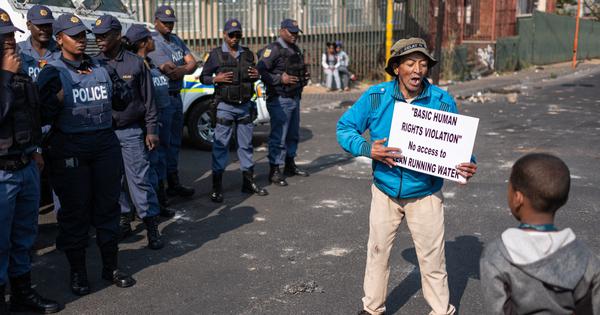
Big cities are having problems with power and water, and roads are in bad shape.
Even the army and police are not working as well as they should, and some people worry about crime.
There are also many accusations of leaders being dishonest.
Despite these problems, South Africa is still a place where people can vote freely, and different political parties can compete.
Some areas, like Cape Town and the Western Cape province, are managed well by a different party, showing that there can be good leadership.
The news and TV are mostly free to say what they think, and the courts try to make sure people follow the law.
Also, the country is good at farming and has beautiful places for tourists, and its universities are some of the best.
These good things give hope that South Africa can improve.

A significant majority of South Africans (80%) believe their country is heading in the wrong direction.
Living standards have stagnated or declined over the past 15 years, with GDP per capita showing little growth.
Youth unemployment remains critically high, with a majority of unemployed young people lacking any prior work experience.
Key infrastructure in cities like Johannesburg experiences frequent failures, and public services are in decline.
Despite widespread corruption allegations and challenges, South Africa maintains democratic elections, press freedom, and an independent judiciary.
- Who
- South African citizens, the ruling African National Congress (ANC), opposition parties, government institutions, and citizens born after 1994.
- What
- Growing dissatisfaction among South Africans due to declining living standards, high unemployment, infrastructure failures, and corruption, despite the country's democratic institutions and other strengths.
- When
- Ongoing, with recent data from Ipsos in September, a Harvard study published in 2023, and statistics from May 2025. The ANC has overseen economic performance for over 15 years, and the Zondo commission concluded in 2022.
- Where
- South Africa, specifically mentioning Johannesburg and national institutions.
- Why
- Declining living standards, prolonged high unemployment, infrastructure decay, a weakened military and police force infiltrated by crime syndicates, and widespread corruption, coupled with decreasing relevance of the 'apartheid legacy' as a scapegoat for current problems.
Challenges and Criticisms
Reasons for Optimism
Economic and Living Standards
Challenges and Criticisms
South Africa has experienced over 15 years of stagnant or declining GDP per capita, coupled with rising unemployment, particularly among youth.
Reasons for Optimism
Strong agricultural and tourism sectors, along with globally competitive universities, provide a foundation for economic renewal.
Governance and Public Services
Challenges and Criticisms
Widespread corruption allegations, infrastructure failures (electricity, water), and a decline in the effectiveness of the military and police force plague the nation.
Reasons for Optimism
The country maintains genuinely democratic elections, a free press ranked highly in Africa, and an independent judiciary capable of holding individuals accountable.
Public Sentiment and Political Relevance
Challenges and Criticisms
A majority of South Africans feel the country is on the wrong track, and the government's reliance on the apartheid legacy to explain current hardships is losing relevance for a generation born after 1994.
Reasons for Optimism
The democratic process provides genuine voter choice, and the performance of opposition-led administrations in regions like the Western Cape offers a model for alternative governance.
- Public Dissatisfaction
- 80% of South Africans believe the country is on the wrong track (Ipsos, Sept. data).
- Economic Performance
- Over 15 years of flatlining or declining GDP per capita (Harvard University study, 2023).
- Youth Unemployment
- Nearly 60% of unemployed youth (4.8 million) have no prior work experience (Dept. of Statistics, May 2025).
- Infrastructure Issues
- Repeated electricity and water failures in Johannesburg, poorly maintained streets.
- Military Capability
- 15-20% of SANDF aircraft are serviceable; limited naval vessels for coastline security.
- Corruption Allegations
- Zondo commission report implicated hundreds of ANC politicians and officials.
- Press Freedom Ranking
- South Africa ranked 27th globally on the 2025 World Press Freedom Index.