

Archive · 29 Sep 2026
Supreme Court Questions Steep Mark-Ups on Essential Medicines
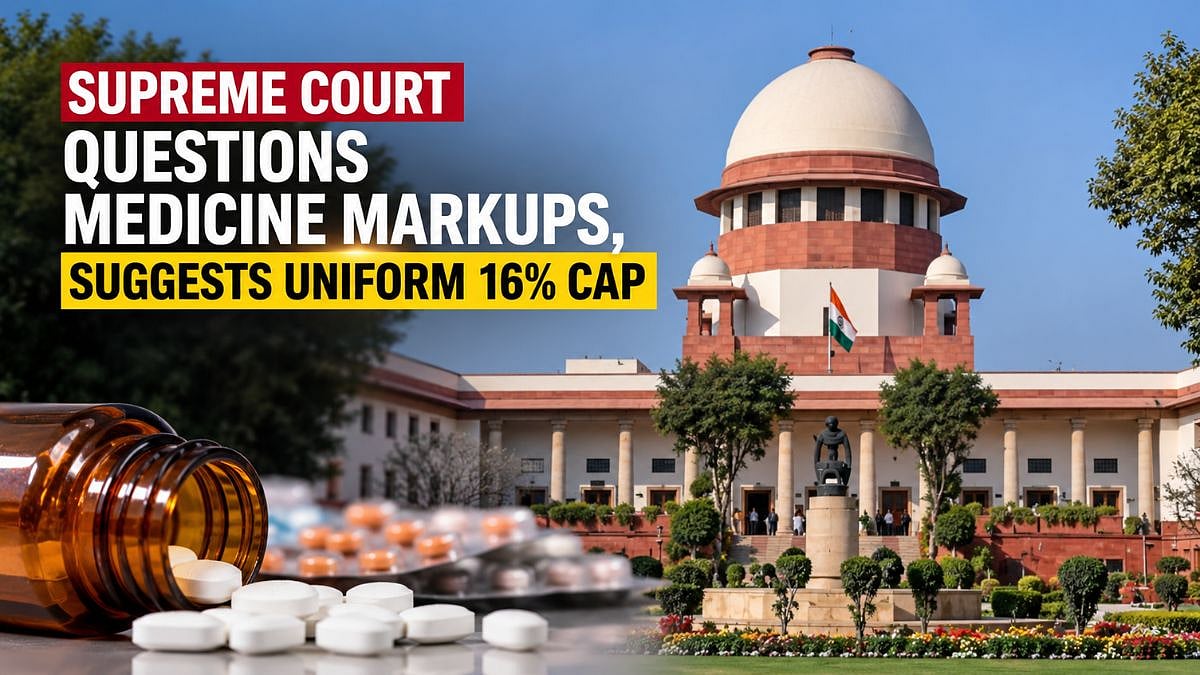
The Supreme Court is examining why some medicines cost much more for patients than they do for retailers.
The judges discussed a cancer drug that reportedly cost retailers about ₹3,000 but had a price of about ₹27,000 for consumers.
They asked whether a 16% limit should apply more widely to medicines and medical devices.
The petitions before the court seek more affordable medicines and stronger enforcement of price controls.
The Centre said private hospitals may receive much of the extra money instead of pharmaceutical companies.
The judges also said some hospitals may make patients use their own pharmacies.
This can leave patients with fewer chances to find cheaper medicines elsewhere.
When public health programs pay for treatment, higher prices can also cost taxpayers more.
The court will hear the matter again on October 12, 2026.

The Supreme Court questioned why a uniform 16% limit or margin should not apply to essential medicines.
Justice Sandeep Mehta cited a cancer drug supplied to retailers for about ₹3,000 but sold with an MRP of approximately ₹27,000.
The Centre said private hospitals, rather than pharmaceutical companies, benefit from many steep mark-ups.
The Bench raised concerns that hospitals may require patients to buy medicines from in-house pharmacies.
The court said inflated prices under schemes such as Ayushman Bharat ultimately burden taxpayers and scheduled the next hearing for October 12, 2026.
- Who
- The Supreme Court of India, the Centre represented by Solicitor General Tushar Mehta, and petitioners Kishan Chand Jain and Sanjay Kulshrestha.
- What
- The court questioned steep medicine mark-ups and examined whether a uniform 16% pricing limit should apply to essential medicines.
- When
- The hearing took place on September 29, 2026; the next hearing is scheduled for October 12, 2026.
- Where
- The matter was heard by the Supreme Court of India; one report datelined the proceedings to New Delhi.
- Why
- The petitions seek affordable medicines and stricter enforcement of drug-price controls, while the court is concerned about patient costs and taxpayer-funded treatment.
Court and Petitioners
Centre's Position
Uniform price control
Court and Petitioners
The Bench questioned why the 16% margin or limit under the Drugs (Prices Control) Order, 2013, should not apply uniformly to essential medicines and medical devices.
Centre's Position
The Centre said a solution must balance competing interests and sought time to provide details of existing drug-pricing mechanisms.
Who benefits from mark-ups?
Court and Petitioners
The court and petitioners highlighted the large gap between retailer prices and consumer MRPs as evidence of alleged overpricing that should be curbed.
Centre's Position
The Centre said pharmaceutical companies are not the main beneficiaries and that private hospitals receive the gains from many steep mark-ups.
Hospital pharmacy purchases
Court and Petitioners
The Bench expressed concern that hospitals requiring patients to use in-house pharmacies may prevent them from obtaining the same medicines more cheaply elsewhere.
Centre's Position
The reports do not provide a specific response from private hospitals to this concern.
- Cancer drug example
- A cancer drug was reportedly supplied to retailers for about ₹3,000 and listed for consumers at approximately ₹27,000.
- Proposed pricing limit
- The Bench questioned why a uniform 16% margin or limit above the price to retailer should not apply to essential medicines.
- Centre's position
- Solicitor General Tushar Mehta said private hospitals, rather than pharmaceutical companies, benefit from steep mark-ups.
- Hospital pharmacies
- The Bench raised concerns that private or corporate hospitals may insist that patients purchase medicines from in-house pharmacies.
- Public funding
- The court said inflated medicine costs under government-funded programs such as Ayushman Bharat are ultimately borne by taxpayers.
- Non-scheduled medicines
- One report said non-scheduled formulations make up about 80% or more of the market by number and value and face fewer pricing restrictions.
- Next hearing
- The matter was posted for further hearing on October 12, 2026.
