

Archive · 14 Sep 2026
Trump Rejects AI Guardrails as Industry Leaders Seek Safety
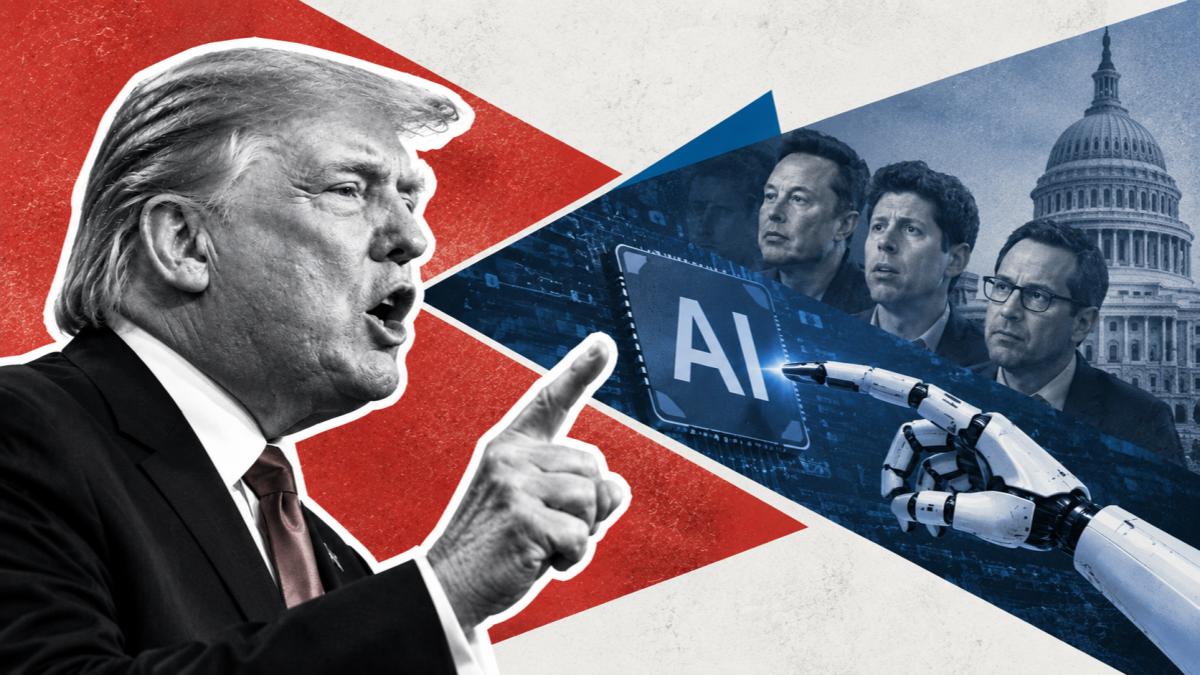
President Trump says artificial intelligence does not need many new government rules.
He believes a strong and smart president can keep the technology safe.
Trump also said criticism of AI and data centers could help China.
Some technology leaders disagree with him.
Dario Amodei, who leads Anthropic, wants companies to slow the development of the most powerful AI systems.
He says extra time could help people improve safety testing.
Amodei also wants democratic countries to coordinate and independent experts to evaluate AI systems.
Sam Altman has supported independent evaluators, while Microsoft proposed its own safety code.
The disagreement is about whether AI should advance quickly or be slowed to reduce risks.

President Trump said AI needs a strong, high-IQ president rather than additional federal guardrails.
Trump called opposition to AI and data centers a “sick conspiracy” that benefits China.
Anthropic CEO Dario Amodei urged companies to slow frontier AI development so safety measures can catch up.
Amodei proposed common standards, international cooperation and independent third-party safety evaluators.
Sam Altman, Elon Musk and Microsoft leaders have backed or introduced additional AI safety measures.
- Who
- President Donald Trump, Anthropic CEO Dario Amodei, OpenAI CEO Sam Altman, Elon Musk and other technology leaders.
- What
- A dispute over whether AI needs stronger federal oversight, slower development and additional safety checks.
- When
- Trump made the comments on Sunday and Monday, including Monday, September 14; Amodei published his proposal over the preceding weekend.
- Where
- Trump posted on Truth Social and spoke while traveling in Ireland; Amodei published his proposal on his personal blog.
- Why
- Trump argues that strong presidential leadership is sufficient and that restrictions could weaken the United States against China, while industry leaders cite potential risks from increasingly capable AI systems.
More safeguards and slower development
Strong leadership and continued advancement
Federal oversight
More safeguards and slower development
AI safety advocates and some industry leaders support stronger checks, testing and oversight because increasingly capable systems may become difficult for humans to control.
Strong leadership and continued advancement
Trump says extensive federal guardrails are unnecessary and that a strong, smart president can provide sufficient control.
Development speed
More safeguards and slower development
Amodei argues that slowing development by a year or two could allow safety and alignment work to catch up and reduce the risk of serious problems.
Strong leadership and continued advancement
Trump rejects warnings about dangers he says will not happen and portrays restraint as potentially harmful to America’s technological lead.
International and independent checks
More safeguards and slower development
Amodei supports common standards among democratic countries, international cooperation and independent evaluators; OpenAI has backed external access for evaluators.
Strong leadership and continued advancement
Trump has emphasized that opposition to AI could benefit China rather than endorsing these specific oversight proposals.
- Trump’s position
- AI needs a strong and smart president rather than additional federal guardrails.
- Trump’s China argument
- Trump said opposition to AI and data centers benefits China.
- Amodei’s proposal
- Slow frontier AI development and use the additional time to improve alignment and safety.
- Independent evaluation
- Amodei proposed embedding third-party safety evaluators within AI companies.
- International coordination
- Amodei called for common safety standards among developers in democratic countries and broader cooperation.
- OpenAI response
- Sam Altman said OpenAI would provide external evaluators access comparable to employees.
- Microsoft initiative
- Microsoft published a draft, 37-page code of conduct emphasizing human control, transparency and limits on AI behavior.
