

Archive · 3 Oct 2026
When Does Crowd Control Become Excessive Police Force?
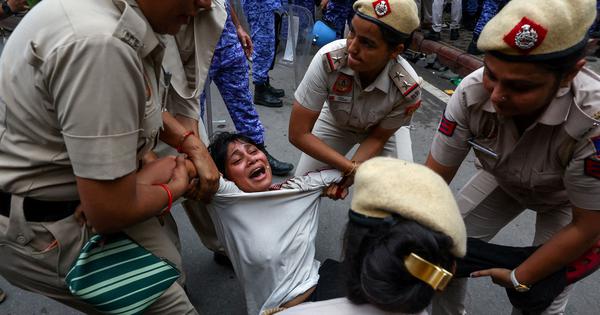
People have the right to gather peacefully, but police also have a duty to keep public order.
The Supreme Court wants an enquiry committee to examine whether police used too much force at a protest in Delhi.
Protesters and witnesses have described serious violence, though those claims are presented as allegations.
Rules say police should try talking and warning first, and use only the least force needed.
Other guidance says officers should reduce injuries and help people who are hurt.
The article says India already has many rules for managing crowds.
But people have still been injured during protests, so the author argues that rules may not be enough.
Clearer procedures and stronger accountability may also be needed.

The Supreme Court asked an enquiry committee to assess whether police used excessive force against protesters at Jantar Mantar on July 20.
Petitioners, witnesses and human rights groups alleged that police used batons, tear gas and other weapons; the article says these accounts describe a severe crackdown.
Indian law protects peaceful assembly while allowing restrictions for public order, and police may use force to disperse assemblies deemed unlawful.
Indian and international guidelines call for restraint and minimum necessary force, while other protocols set out training, barricading and escalation procedures.
The article argues that rules alone have not prevented injuries, pointing to concerns about vague procedures, weak accountability and police attitudes toward force.
- Who
- The Supreme Court, an enquiry committee, police and protesters.
- What
- The committee was asked to examine whether police used excessive force at a protest and what a proportionate response to assemblies should be.
- When
- The protest in question took place on July 20; the article does not specify the year.
- Where
- Jantar Mantar, Delhi, India.
- Why
- To assess the limits of police force while balancing public order with the constitutional right to peaceful assembly.
Peaceful Assembly and Restraint
Public Order and Police Powers
When police may use force
Peaceful Assembly and Restraint
Police should avoid force where practicable and use only the minimum necessary, while protecting peaceful dissent and limiting injuries.
Public Order and Police Powers
Police are empowered to disperse assemblies deemed unlawful and a threat to public peace, subject to applicable restrictions and procedures.
How to judge a crowd
Peaceful Assembly and Restraint
The article argues that decisions should account for the threat posed, crowd composition, opportunities to de-escalate and whether an escape route exists.
Public Order and Police Powers
Police protocols provide staged responses, barricading and escalation procedures for managing public agitations.
- Protest under examination
- A protest at Jantar Mantar on July 20; the year is not stated.
- Constitutional provision
- Article 19(1)(b) protects peaceful assembly without arms; Article 19(3) permits restrictions in specified interests, including public order.
- Home Ministry guidance
- 1985 code-of-conduct guidelines recommend persuasion, advice and warning, and the irreducible minimum of force when force is inevitable.
- UN principles
- The UN Basic Principles call for avoiding force where practicable and limiting it to the minimum necessary.
- Delhi Police orders
- Standing orders cited in the article call for restraint and use of force in a way that causes the least possible injury.
- Police personnel survey
- A 2025 survey of more than 8,276 police personnel across 17 states and union territories found that over 70% said police should be able to use force without fear of punishment.
- Supreme Court precedent
- In the 2012 Ramlila Maidan case, the Supreme Court found that Delhi Police had ignored guidelines and common prudence during a baton charge and tear-gas operation.