

Archive · 31 Jul 2026
NASA Observes Rare Orphan Black Hole Shredding Star
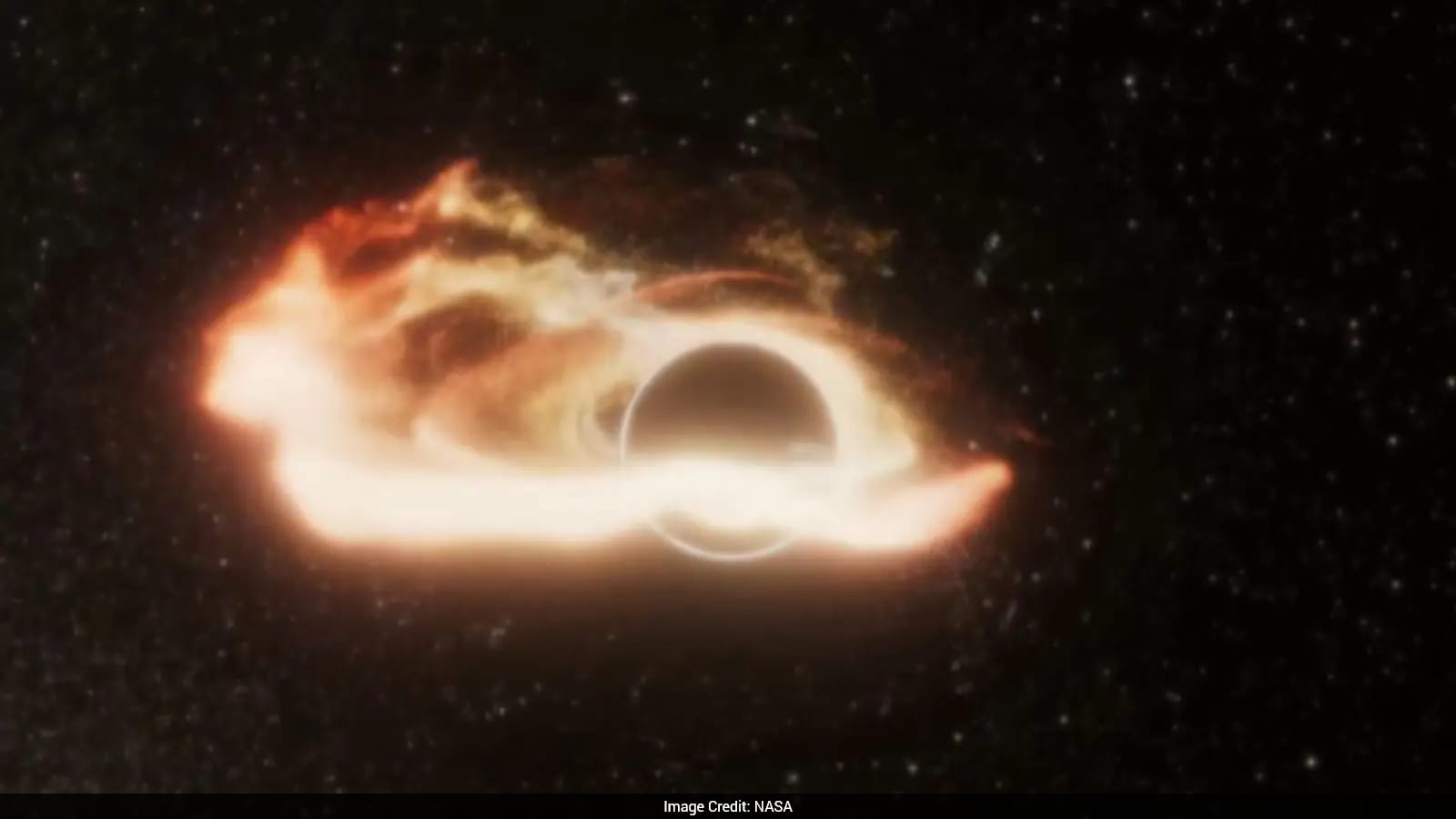
NASA’s telescopes saw a star get ripped apart by a huge black hole that isn’t in the middle of its galaxy.
The black hole is about a million times heavier than our Sun.
Scientists found the event because a computer looked at many bright flashes in space and spotted one that looked like a star being shredded.
They used several telescopes to measure how hot and bright the flare was.
This discovery shows a new way to find black holes that hide far from the center of galaxies.

NASA’s Neil Gehrels Swift Observatory captured a tidal disruption event of a star by a million‑solar‑mass black hole far from a galaxy’s core.
The event, discovered by Zwicky Transient Facility in a galaxy 750 million light‑years away, was the most distant orphan black hole event ever seen.
Scientists used AI to flag the flare among half a million nightly detections, confirming it as a tidal disruption event.
Observations from Swift, SOAR, and other telescopes measured the flare’s temperature at ~54,000 °F and its luminosity at about 10 billion suns.
The finding opens a new method to locate hidden supermassive black holes outside galactic centers.
- Who
- NASA scientists including Robert Stein and Jonathan Carney
- What
- Observed a star being torn apart by a black hole far from a galaxy’s core
- When
- Discovered in November 2025, observed by Swift thereafter
- Where
- Galaxy about 750 million light‑years away, outskirts of the galaxy
- Why
- To locate hidden supermassive black holes that wander outside galactic centers
- Event Type
- Tidal Disruption Event
- Black Hole Mass
- ≈1 million solar masses
- Distance to Galaxy
- 750 million light‑years
- Flare Temperature
- ≈54,000°F (30,000°C)
- Discovery Method
- AI algorithm on ZTF data