

Science & Tech · Science & Environment · 1 hr ago
Tiny primordial black holes could trigger stars to explode from within
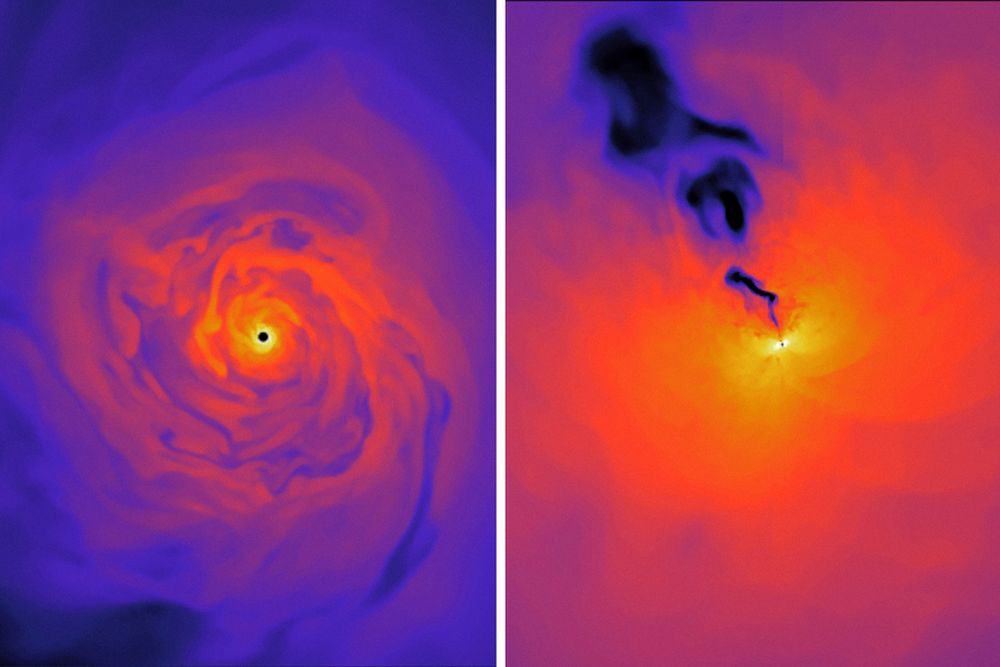
Researchers modeled how primordial black holes could destroy stars from within if these ancient objects exist.
Primordial black holes may have formed just after the Big Bang, and some surviving examples could be as small as an atom but carry the mass of an asteroid.
Scientists have proposed that they could account for some or all of dark matter, which cannot be seen directly.
A lone star is unlikely to capture one, but a companion star or planet could help trap it in a system.
After entering a star, the black hole could take thousands or millions of years to reach its center.
If the star spins fast enough, a disk could form around the black hole, powering jets that punch through the star and make it explode within seconds.
The resulting burst could emit blue and ultraviolet light, X-rays and gamma rays, giving telescopes a possible way to search for these black holes.
The research is theoretical, and the team says observations could test whether primordial black holes exist.

Researchers say tiny primordial black holes could destroy stars from within, potentially producing detectable explosions.
The study examines asteroid-mass black holes that may have formed shortly after the Big Bang and could still exist today.
A star generally would need a companion star or planet to capture one, according to the research.
If the black hole reaches the star’s center and spins fast enough, it could form an accretion disk and launch jets that destroy the star.
The findings are theoretical and were published in The Astrophysical Journal.
- Who
- Researchers led by Ore Gottlieb, an assistant professor of physics at MIT, studied the possibility.
- What
- The study proposes that primordial black holes inside stars could trigger explosive stellar destruction.
- When
- The research was published on November 23, 2026, by Universe Today and November 24, 2026, by ScienceDaily.
- Where
- The proposed events would occur inside stars; the study was published in The Astrophysical Journal.
- Why
- Researchers are investigating whether interactions with stars could help detect primordial black holes, which may account for some or all of dark matter.
This story does not have two clearly opposing sides.
Primordial black holes may have formed from the collapse of dense regions of matter.
A primordial black hole could take thousands or millions of years to reach a star’s center.
The black hole could consume about 1% of the star’s mass over a few million years.
Jets could emerge from inside the star and cause it to explode within seconds.
- Lead author
- Ore Gottlieb, MIT
- Possible black hole mass
- Asteroid mass
- Possible black hole size
- No larger than an atom
- Study journal
- The Astrophysical Journal
- Capture aid
- A companion star or planet could help trap a primordial black hole inside a star
- Proposed explosion signals
- Blue and ultraviolet light, X-rays and gamma rays
3 sources
What people are saying
Once the disk forms, this is essentially a death sentence for the star
There is hope for us to probe primordial black holes through interactions with stars
The black hole is also spinning, and it’s twisting space and time
This twisted magnetic field will power very strong electromagnetic jets from the poles of the black hole