

Science & Tech · Space · 4 hrs ago
LOFAR Produces Its Deepest, Most Detailed Low-Frequency Radio Image
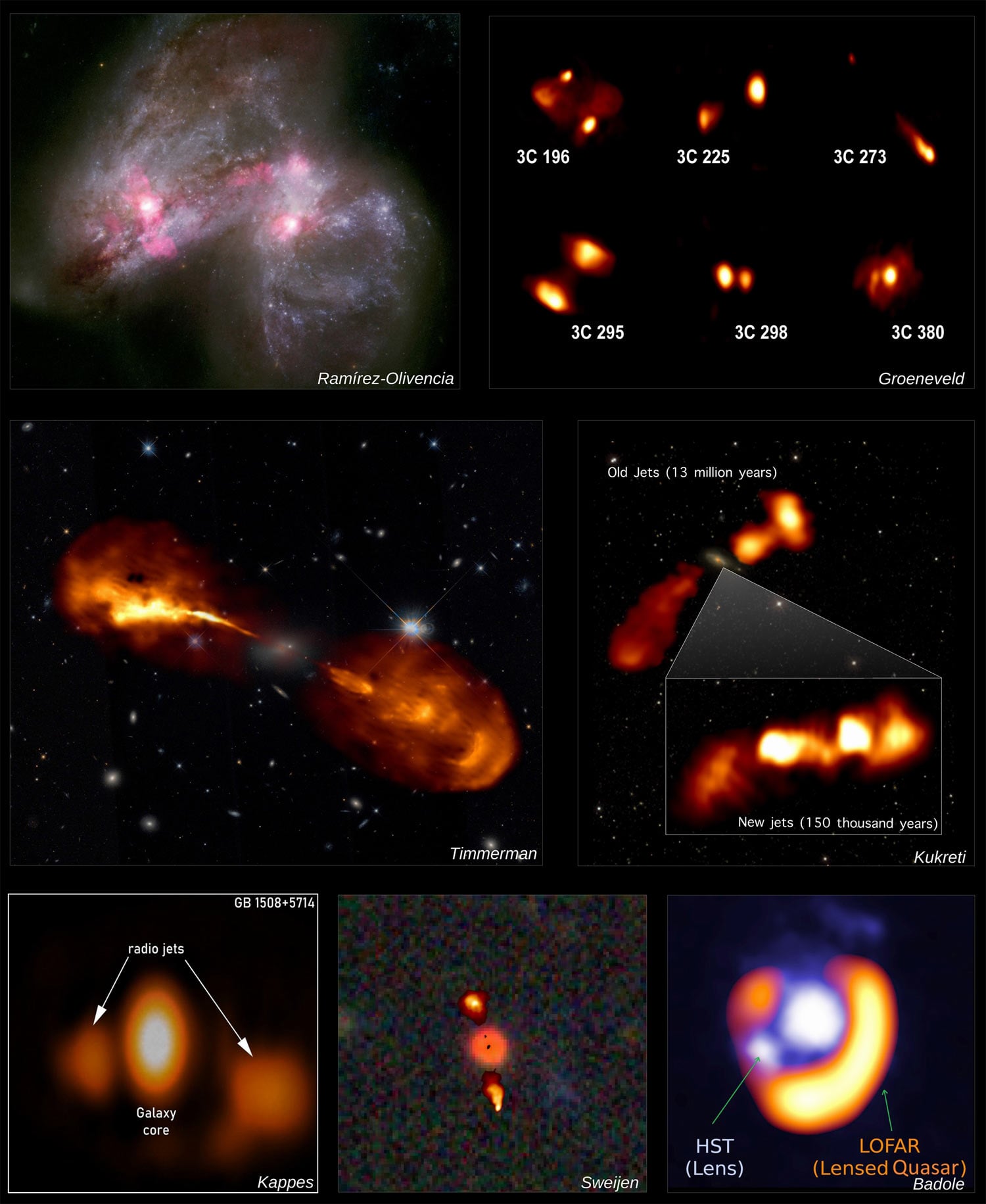
An international team led by Leiden University researchers used the LOFAR radio telescope to create a detailed image of ELAIS-N1, a region of the northern sky.
The image contains 63,000 radio sources, including quasars and galaxies where stars are forming.
It was made from 200 hours of observations and has 20 times the resolution of the earlier LOFAR image.
Better resolution helps astronomers distinguish individual galaxies and trace jets of material from black holes, which previously looked like indistinct patches.
This matters because the observations can help scientists study how jets affect their surroundings and how galaxies change over time.
Planned LOFAR upgrades aim to enable wider, higher-resolution images, according to the research team.

An international team led by Leiden University researchers has produced the deepest and most detailed image yet of low-frequency radio sources.
The team used the LOFAR array to observe ELAIS-N1, a region of the northern sky with little galactic dust, gas or stars.
The image contains 63,000 radio sources, including quasars and star-forming galaxies, and has twenty times the resolution of the previous LOFAR image.
It was made from 200 hours of observations and contains 400 terabytes of data in an 8-billion-pixel image.
The improved view reveals details of radio galaxies and their jets, giving scientists new ways to study how galaxies evolve.
- Who
- An international team led by researchers from Leiden University.
- What
- The team produced the deepest and most detailed low-frequency radio image to date using LOFAR.
- When
- Published on November 13, 2026. The observations took 200 hours.
- Where
- ELAIS-N1, a region of the northern sky.
- Why
- To map low-frequency radio sources and study distant galaxies, their jets and their evolution.
This story does not have two clearly opposing sides.
Astronomers at the LOFAR observatory observed ELAIS-N1 to map low-frequency radio sources.
The team collected the observations used to make the image.
The full dataset was processed on the Spider platform.
- Radio sources
- 63,000
- Observation time
- 200 hours
- Data volume
- 400 terabytes
- Image size
- 8 billion pixels
- Resolution
- Twenty times that of the previous LOFAR image
- Observed region
- ELAIS-N1, northern sky
What people are saying
The entire dataset could be processed on Spider, the high-performance data processing platform hosted at SURF in the Netherlands, in just a few months