

Science & Tech · Science & Environment · 5 hrs ago
Study Finds a Black Hole Could Split Under Rare Conditions
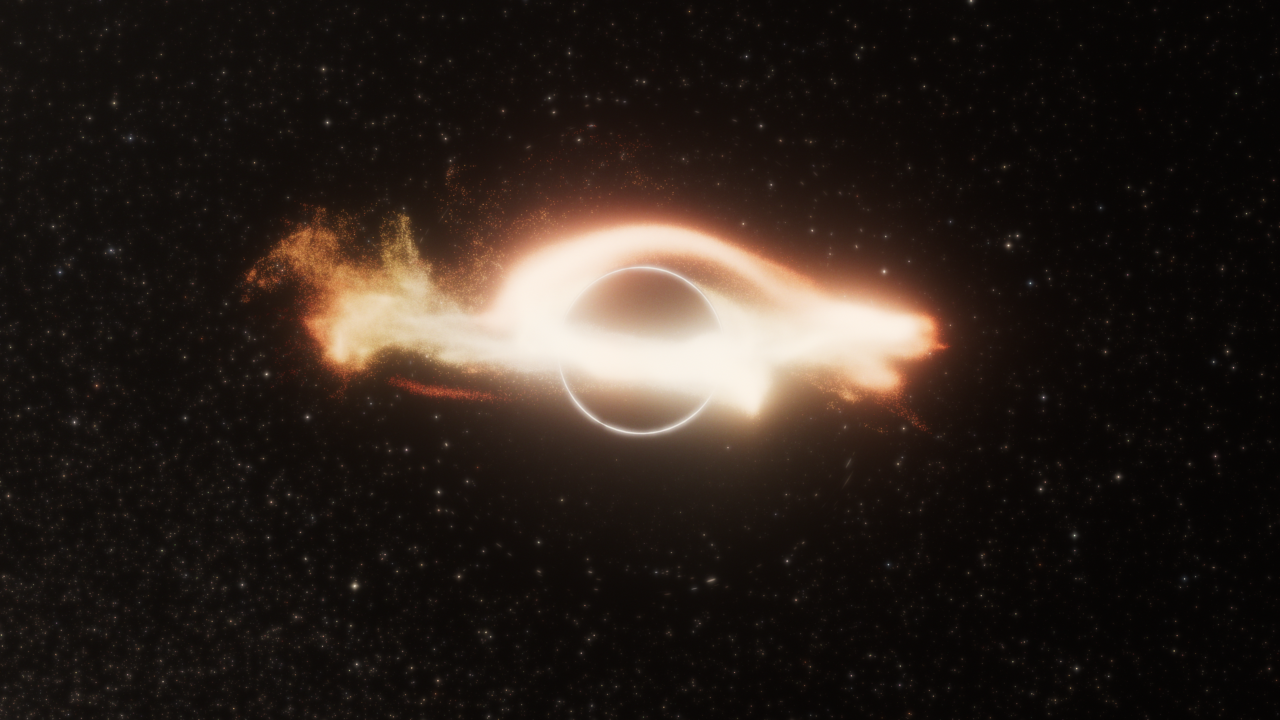
Scientists calculated how a black hole could split into two under certain conditions.
The study involved researchers in Europe, including scientists from the University of Naples Federico II in Italy and the University of Southern Denmark.
The possibility is limited to black holes spinning near their maximum rate, because splitting an ordinary, non-rotating black hole would reduce its entropy and be thermodynamically unlikely.
The two resulting black holes would have to move apart quickly or they could fall back together.
No such split has ever been observed, so the idea remains theoretical.
The chance depends on how gravity behaves beyond Einstein’s theory, and the researchers say they are working to quantify it.

A team of researchers calculated that a black hole could split into two under specific conditions.
The possibility appears limited to rapidly rotating black holes, and the two resulting black holes would need to separate rather than fall back together.
The calculations describe a theoretical possibility; no black hole split has been observed.
The researchers said the likelihood cannot yet be quantified and depends on how gravity behaves beyond Einstein’s theory.
- Who
- Francesco Sannino, Giacomo Cacciapaglia, Manuel Del Piano and Vania Vellucci conducted the calculations.
- What
- The study examined whether a black hole could fragment into two black holes under specific conditions.
- When
- The article was published on 2026-10-30; the study date is not stated.
- Where
- The researchers were affiliated with institutions in Italy, Denmark and France.
- Why
- The team investigated how rotation and changes in the relationship between mass, angular momentum and entropy might allow fragmentation.
This story does not have two clearly opposing sides.
This story does not have a timeline yet.
- Researchers
- Francesco Sannino, Giacomo Cacciapaglia, Manuel Del Piano and Vania Vellucci
- Publication date
- 2026-10-30
- Possible outcome
- One black hole could split into two black holes
- Proposed condition
- The black holes may need to rotate close to their maximum possible rate
- Observed cases
- None reported
What people are saying
The two resulting black holes must also be able to separate rather than immediately fall back together. When we include this requirement, the window largely closes again, except possibly for black holes rotating close to their maximum possible rate.
We cannot yet give a single probability for a black hole to split. It depends on how gravity behaves beyond Einstein’s theory, and we are working to quantify this,