

Health · Medical Research · 18 hrs ago
MIT team finds 35% antigen density boosts cancer vaccine response in mice
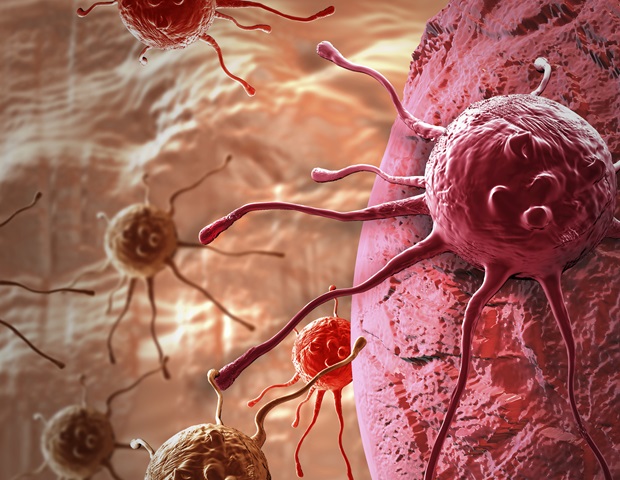
MIT researchers engineered a harmless virus called M13 to carry proteins that help the immune system recognize cancer.
The team adjusted how densely those proteins appeared on the virus, testing levels from about 6% to 70%.
A 35% antigen density produced the strongest response in one test, with mice making more cancer-targeting T cells and showing better protection from tumors.
The researchers also tested a cancer-specific protein from a mouse colon tumor and found that vaccinated mice were less likely to develop tumors.
The work tested prevention in mice, rather than treatment of existing cancers, and has not been tested in people.
M13 may also help stimulate the immune system itself, potentially removing the need for a separate booster ingredient.
Further studies must test safety and effectiveness against existing tumors and determine whether the findings translate to humans.

MIT researchers engineered M13 bacteriophages to carry cancer-targeting antigens at adjustable densities.
In mice, a vaccine particle with 35 percent antigen density gave stronger protection against tumors than one with 6 percent.
The team also tested the platform with a neoantigen found in a mouse model of colon tumors.
The approach is at the preclinical stage and has not been shown to work in people.
- Who
- Researchers at MIT, led by research scientist Shengnan Huang, with Angela Belcher as senior author.
- What
- They adjusted the density of cancer-targeting antigens on M13 virus particles. In mice, a 35 percent density produced stronger protection than a 6 percent density.
- When
- The study was reported on October 31, 2026.
- Where
- At the Massachusetts Institute of Technology and in mouse studies.
- Why
- To investigate how antigen density affects immune responses and whether the particles could support personalized cancer vaccines.
This story does not have two clearly opposing sides.
The team engineered M13 particles displaying the model antigen SIINFEKL at densities from 6 to 70 percent.
In mice, the 35 percent-density vaccine provided stronger protection than the 6 percent-density vaccine.
The team tested the platform with ADPGK, a neoantigen found in a mouse model of colon tumors.
- Vaccine platform
- Modified M13 bacteriophage
- Antigen-density range
- 6 to 70 percent
- Density with stronger protection
- 35 percent
- Model antigen
- SIINFEKL
- Colon-tumor neoantigen
- ADPGK
- Research stage
- Preclinical; results have not been established in humans