

Science & Tech · Science & Environment · 2 hrs ago
Roman rule reshaped Iberia’s ancestry more than later migrations
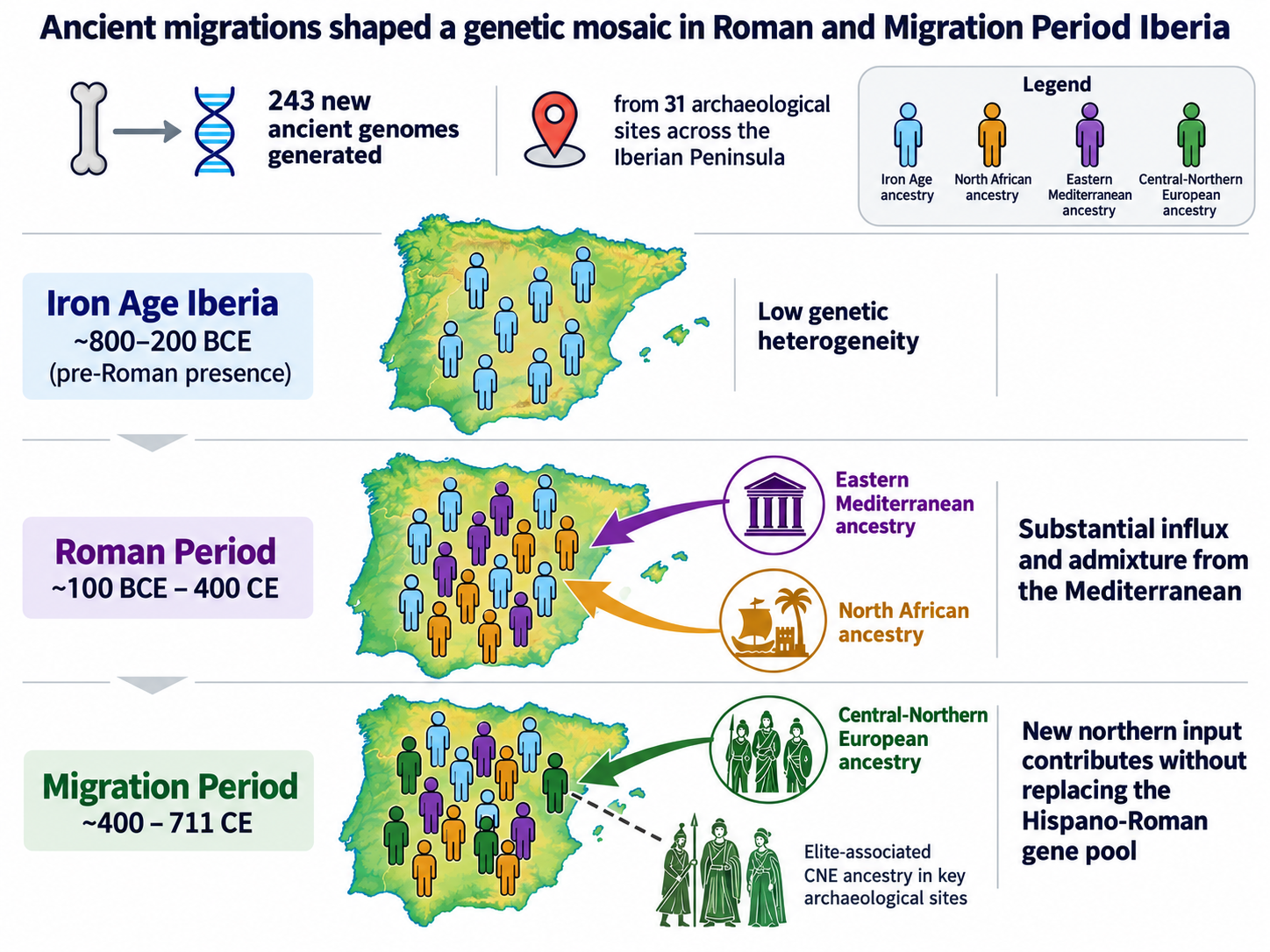
Researchers analyzed DNA from people who lived in Iberia between 100 and 800 CE.
They found that Roman rule brought the larger shift in ancestry, with eastern Mediterranean and North African ancestry appearing in the region.
Eastern Mediterranean-related ancestry was found in 55 of 66 people from the Roman period, though its levels varied by region.
Later migrations brought Central and Northern European-related ancestry, but the study found no widespread replacement of the Hispano-Roman population.
Two siblings buried about 725 kilometres apart also point to long-distance movement among migrant groups.
The findings suggest that the demographic effects of Roman expansion in Iberia were more pronounced than those of the migrations that followed.

A study of ancient DNA found that Roman rule brought greater demographic change to Iberia than the migrations that followed.
Roman-period samples showed ancestry linked to the eastern Mediterranean, and the study also reported North African ancestry in Iberia.
Later migrations introduced Central-Northern European-related ancestry without widespread replacement of the Hispano-Roman population.
Researchers identified siblings buried about 725 kilometres apart, indicating long-distance movement among migrant groups.
The study analyzed remains from people who lived in Iberia between 100 and 800 CE.
- Who
- Researchers studying ancient DNA from people who lived in Iberia.
- What
- The study found that Roman rule was associated with greater demographic change than later migrations. It also identified siblings buried about 725 kilometres apart.
- When
- The remains studied date from 100 to 800 CE. The article was published on 25 October 2026.
- Where
- The Iberian Peninsula.
- Why
- To investigate how Roman expansion and early medieval migrations affected Iberia’s genetic makeup.
This story does not have two clearly opposing sides.
Rome entered Iberia during the Second Punic War.
The study’s samples covered people who lived in Iberia during this period.
Roman control weakened as Germanic and Alan groups gained political influence.
News-Medical published its report on the study.
- Newly analyzed individuals
- 212
- People from previous research
- 58
- Roman-period individuals with eastern Mediterranean-related ancestry
- 55 of 66
- Eastern Mediterranean-related ancestry
- 4.1% in Augusta Emerita to 34.6% in southeastern Iberia
- Distance between siblings’ burial sites
- Approximately 725 km