

Science & Tech · Science & Environment · 1 hr ago
New X-ray detector surface captures more light while preserving sharpness
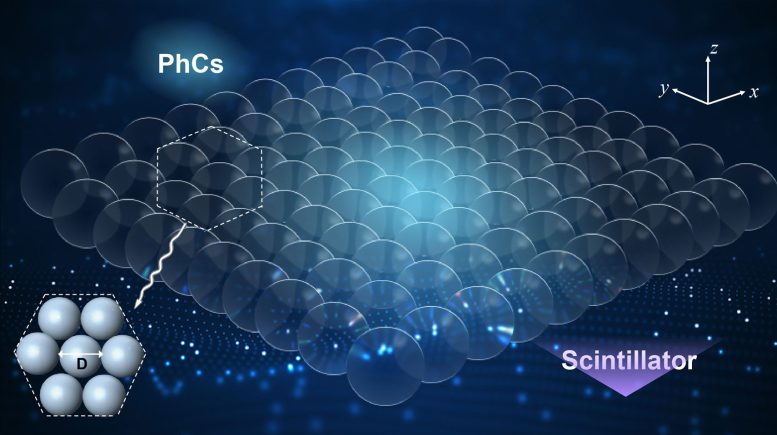
Researchers at Chongqing University, the 26th Institute of CETC and Stevens Institute of Technology developed a nanostructured surface for X-ray detectors.
X-ray detectors use scintillators to turn X-rays into visible light, but much of that light can remain trapped inside the material.
The new surface uses an ordered layer of tiny plastic spheres to help more trapped light escape and reach the detector.
In tests, it produced 4.64 times more light and improved the imaging signal-to-noise ratio by 13 decibels.
The system kept spatial resolution finer than 25 micrometres, addressing the trade-off between stronger signals and sharp detail.
The approach could support clearer scans with lower radiation doses, as well as security screening and industrial inspections; the researchers describe experimental results, with no further steps specified.

Researchers developed a nanostructured surface that lets more light escape an X-ray detector without reducing image sharpness.
The surface increased average light output by 4.64 times and improved the imaging signal-to-noise ratio by 13 decibels.
The experimental system maintained spatial resolution finer than 25 micrometres.
The team used a self-assembly process to form a layer of polystyrene nanospheres on a GAGG scintillator wafer.
The approach could support clearer imaging in medical scans, security screening and industrial inspections.
- Who
- Researchers from Chongqing University, the 26th Institute of CETC and Stevens Institute of Technology.
- What
- They developed a nanostructured scintillator surface that increases light output while preserving image sharpness.
- When
- The article was published on 2026-11-01.
- Where
- The method was demonstrated on a 25 mm GAGG scintillator wafer. The researchers’ institutions are in China and the United States.
- Why
- The surface helps release light that would otherwise be trapped inside the scintillator, improving imaging when X-ray signals are weak.
This story does not have two clearly opposing sides.
This story does not have a timeline yet.
- Average light output
- Increased by 4.64 times
- Signal-to-noise ratio
- Improved by 13 decibels
- Spatial resolution
- Finer than 25 μm
- Wafer diameter
- 25 mm
- Scintillator
- GAGG:Ce
- Publication
- Opto-Electronic Advances