

Science & Tech · Science & Environment · 2 hrs ago
Elephant Fossils Reveal a Wetland Refuge for Early Humans in Northern Israel
Researchers examined tooth and tusk fossils from a giant elephant found at Gesher Benot Ya’aqov in northern Israel.
The remains belonged to a straight-tusked elephant that lived nearly 700,000 years ago, during the Pleistocene.
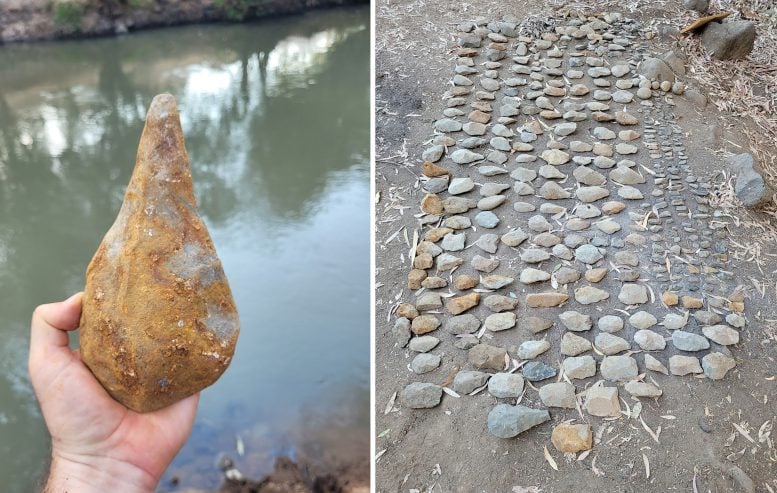
Nearby basalt handaxes and cleavers show that early humans using Acheulian tools were also present at the site.
By studying the fossils’ structure, wear and chemical composition, along with pollen from the sediments, the team reconstructed a landscape of rivers, marshes, woodlands and grasslands.
The findings suggest the Hula Valley was a stable refuge with reliable water and food for animals and human groups moving through the region.
The site lay along the Levantine Corridor, a land bridge between Africa and Eurasia, so understanding its past environment may help explain where people and wildlife could survive and travel; the study offers no further next steps.

Researchers used elephant fossils from northern Israel to reconstruct a wetland-rich environment that existed nearly 700,000 years ago.
The remains belonged to a straight-tusked elephant and were found alongside Acheulian stone tools.
Analyses indicate the landscape included woodlands, grasslands, marshes, rivers and shallow-water habitats.
The study suggests the Hula Valley region was a stable ecological refuge for wildlife and early human groups moving through the Levantine Corridor.
- Who
- Researchers led by Hannah Farrell, a PhD candidate at Haifa University, studied the fossils.
- What
- The study used elephant remains to reconstruct an ancient ecosystem shared by large mammals and early human toolmakers.
- When
- Nearly 700,000 years ago. The study was published in Quaternary Science Reviews.
- Where
- Gesher Benot Ya’aqov in northern Israel, in the Jordan Rift Valley south of today’s Hula Valley.
- Why
- Researchers aimed to understand the environment and resources available to animals and early humans.
This story does not have two clearly opposing sides.
This story does not have a timeline yet.
- Site
- Gesher Benot Ya’aqov, northern Israel
- Age
- Nearly 700,000 years
- Elephant species
- Palaeoloxodon antiquus, the straight-tusked elephant
- Stone tools
- Basalt handaxes and cleavers of the Acheulian tradition
- Study methods
- CT scanning, 3D reconstruction, microscopic wear analysis, isotope geochemistry and pollen studies
What people are saying
understanding how humans and animals responded to environmental change hundreds of thousands of years ago helps us better understand the forces that shaped our species.
The availability of water, vegetation, and animal resources shaped where humans and wildlife could survive,