

Science & Tech · Space · 5 hrs ago
Milky Way planetary systems fall into two families, study finds
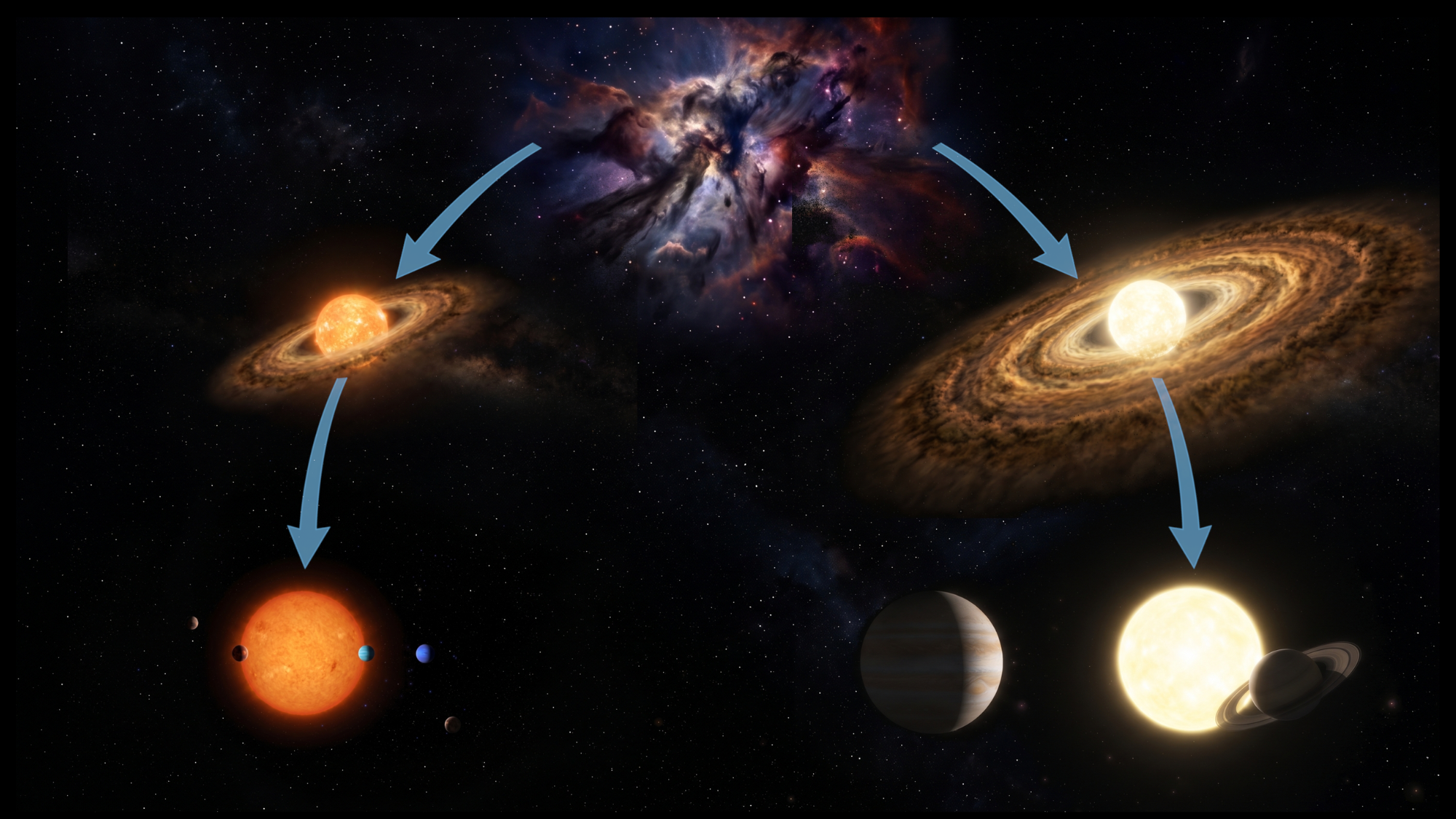
Researchers found two families of planetary systems in the Milky Way after studying 300 well-understood systems with multiple planets.
The study was led by researchers at Italy’s National Institute for Astrophysics and examined a portion of the more than 1,000 multiplanet systems discovered in our galaxy.
One family has wide, massive systems around more massive stars with lower concentrations of elements heavier than hydrogen and helium.
The other has compact, lower-mass systems with planets of similar size and mass, orbiting stars no more massive than the Sun.
The researchers found that violent gravitational events were more common in the first family, including collisions and planets being ejected.
The stars’ properties are linked to how systems evolve, which could help astronomers identify systems with potentially habitable planets as they search for life beyond our solar system.

A study found that Milky Way planetary systems fall into two distinct families linked to the stars around which they formed.
Researchers at the Italian National Institute for Astrophysics studied 300 of the best-understood multiplanet systems.
One family consists of wide, massive systems around stars more massive than the sun and with lower concentrations of heavy elements.
The other family is more compact and lower in mass, with planets of comparable sizes and masses orbiting stars no more massive than the sun.
The researchers found that violent events, including giant collisions and planetary ejections, were more common in the first family.
- Who
- Researchers led by the Italian National Institute for Astrophysics conducted the study.
- What
- They identified two families of planetary systems and found that the systems’ stars are linked to their characteristics and evolution.
- When
- The study was published on October 14, 2026.
- Where
- The study examined multiplanet systems in the Milky Way.
- Why
- The researchers investigated what determines the characteristics of planetary systems and whether they are set at birth or shaped over time.
This story does not have two clearly opposing sides.
This story does not have a timeline yet.
- Systems studied
- 300 of the best-understood multiplanet systems
- First family
- Often has a total mass between two and 10 times that of the solar system
- Second family
- Compact, lower-mass systems with planets of comparable masses and sizes
- Common instability
- Violent events were more common in the first family
What people are saying
The fundamental question we started from was: What determines the characteristics of planetary systems as we see them today? Are they established at birth or sculpted by evolution over time? The truth, in the end, turned out to lie somewhere in the middle,
Our results show that there is a genetic link between planetary systems and their stars, and that, depending on the star around which they are born, this link also determines their fate,
The main difficulty during the data analysis was determining whether the two families of planetary systems were real or just an illusion created by the technological limits of current observational techniques,