

Science & Tech · Science & Environment · 13 hrs ago
Controversial Nemesis theory links comet showers to mass extinctions
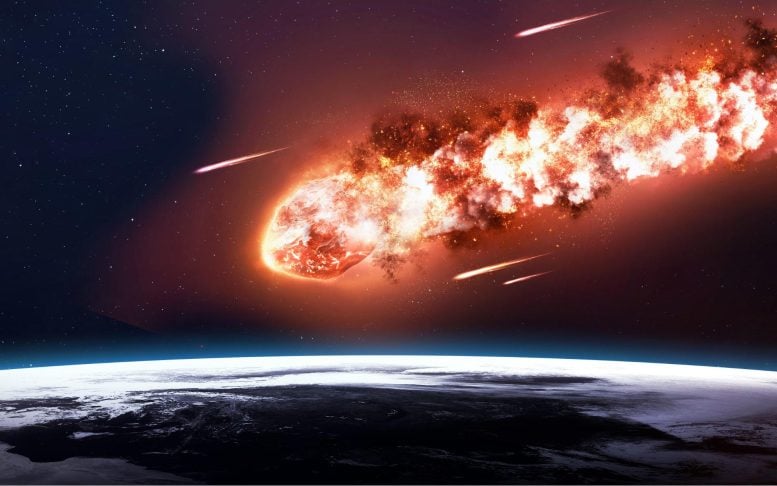
Physicist Richard Muller proposes that an unseen red dwarf star called Nemesis orbits with the Sun and periodically disturbs distant comets.
Those comets are thought to come from the Oort Cloud, a vast, still-mysterious reservoir of icy objects far beyond the planets.
Muller suggests Nemesis could pass through dense parts of the cloud and send comet showers toward the inner solar system.
The idea draws on a study that identified marine extinction events at intervals of about 26 million years, including the extinction that wiped out the dinosaurs 66 million years ago.
Nemesis remains hypothetical and has not been directly detected, and the theory is controversial.
Muller says its motion alongside the Sun could help explain why it has not been seen, but no future test or discovery is specified.

Richard Muller’s controversial Nemesis hypothesis proposes that an unseen red dwarf companion to the Sun periodically sends comets toward Earth.
The proposed star could disturb the Oort Cloud, a distant reservoir of icy bodies, as it passes through it.
Muller says the resulting comet showers could last about a million years and recur roughly every 26 million years.
He links this cycle to a pattern of marine extinctions described in a 1982 study, including the extinction 66 million years ago that wiped out the dinosaurs.
Nemesis has not been directly observed, and the article reports no clear evidence confirming the hypothesis.
- Who
- Physicist Richard Muller proposed the Nemesis hypothesis. Astrophysicist Sean Raymond described possible sources of material in the Oort Cloud.
- What
- The hypothesis says an unseen red dwarf companion to the Sun periodically redirects comets toward the inner solar system.
- When
- Muller proposes a cycle of roughly 26 million years. The article also notes an extinction peak 66 million years ago.
- Where
- The proposed encounters would take place in the Oort Cloud, a distant reservoir of icy bodies around the Sun.
- Why
- Muller suggests the mechanism could explain a recurring pattern of impacts and mass extinctions on Earth.
Nemesis hypothesis supporters
Astronomers questioning the hypothesis
Existence of Nemesis
Nemesis hypothesis supporters
Muller supports the idea that the Sun has a low-mass red dwarf companion.
Astronomers questioning the hypothesis
Many astronomers assume that an ordinary red dwarf companion would have been seen.
Explanation for extinction patterns
Nemesis hypothesis supporters
Muller argues that recurring comet showers could help explain extinction events roughly every 26 million years.
Astronomers questioning the hypothesis
The article does not state an alternative explanation from the opposing astronomers.
An extinction peak at the KT boundary wiped out the dinosaurs.
Paleontologists David Raup and Jack Sepkoski published a study compiling a record of marine extinctions.
- Proposed cycle
- Roughly every 26 million years
- Proposed comet showers
- Lasting roughly a million years
- Oort Cloud extent
- As far as 1.6 light-years from the Sun
- Extinction record study
- Published in 1982 by David Raup and Jack Sepkoski
- Dinosaurs’ extinction
- 66 million years ago
1 source
What people are saying
Well, maybe there’s a companion star that comes close in to the Oort Cloud every 26 million years, and then triggers a comet hitting Earth.
Despite what others seem to think, there is no clear evidence against this hypothesis,