

Science & Tech · Science & Environment · 1 hr ago
Crude-oil membrane could cut refinery energy use by nearly a third
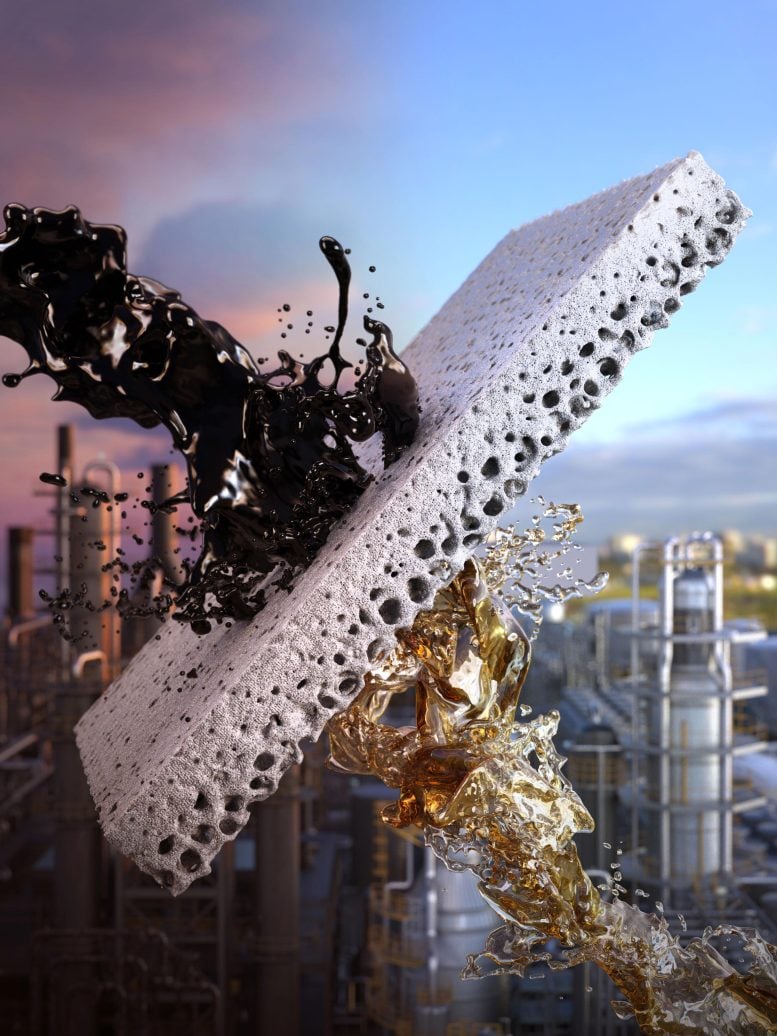
Refineries heat crude oil above 350°C to separate it into useful components, a process that consumes large amounts of energy worldwide.
Researchers tested a membrane that separates crude oil at room temperature using KAIST and Georgia Tech teams, with real oil supplied by HD Hyundai Oilbank.
As oil passes through an inexpensive porous polymer, heavy hydrocarbons build up on the pore walls and form tiny channels.
Lighter components pass through while heavier ones are held back, turning a buildup that usually harms membranes into the means of separation.
In a 28-day test, the membrane’s oil flow rate was about 23 times higher than previously reported membranes for crude oil.
Simulations suggest pretreatment could cut energy use by 31.6% and carbon dioxide emissions by 37.6% when combined with conventional distillation.
The researchers aim to control the channel-forming process and develop the technology for broader use in refining, but adoption has not yet been established.

Researchers demonstrated a simple membrane that separates lighter components from crude oil at room temperature.
The membrane uses deposits from the oil to form narrow channels that retain heavier components and let lighter ones pass through.
Process simulations suggest that using the membrane before distillation could cut energy use by 31.6%.
The simulations also estimate lower carbon dioxide emissions, cooling water use and operating costs.
The study was published in Nature and was led by researchers at KAIST with collaboration from Georgia Tech.
- Who
- An international research team led by Professor Dong-Yeun Koh of KAIST, working with Professor Ryan Lively’s group at Georgia Tech.
- What
- The team demonstrated a porous membrane that separates lighter and heavier crude-oil components. Simulations suggest it could reduce energy use when used before distillation.
- When
- The study was published on October 23, 2026.
- Where
- The research involved KAIST and Georgia Tech. The crude oil was supplied by HD Hyundai Oilbank.
- Why
- To make crude-oil separation more efficient and reduce the energy and other resources used in refining.
This story does not have two clearly opposing sides.
Process simulations found that pretreating crude oil with the membrane could reduce energy consumption by 31.6%.
The study was published in Nature.
- Energy use
- Simulated reduction of 31.6% when used before distillation
- Carbon dioxide emissions
- Simulated reduction of 37.6%
- Cooling water
- Simulated reduction of 20.7%
- Operating costs
- Simulated reduction of 36%
- Membrane material
- Porous polyacrylonitrile (PAN)
- Steady performance
- 28 consecutive days
What people are saying
This study reveals a new scientific principle in which a membrane interacts with a complex mixture and spontaneously forms its own separation channels. Working with real crude oil supplied by HD Hyundai Oilbank allowed us to validate the technology under conditions relevant to industrial operation.
One of the key challenges facing membrane systems for crude oil separation was the low productivities of the membrane units – the PAN membranes with their surprising separation mechanism – dramatically increase the productivity of the membrane unit, to the point where industry should seriously consider adopting the technology.