

Science & Tech · Space · 8 hrs ago
Detailed observations reveal clues about Pa 30 and its zombie star
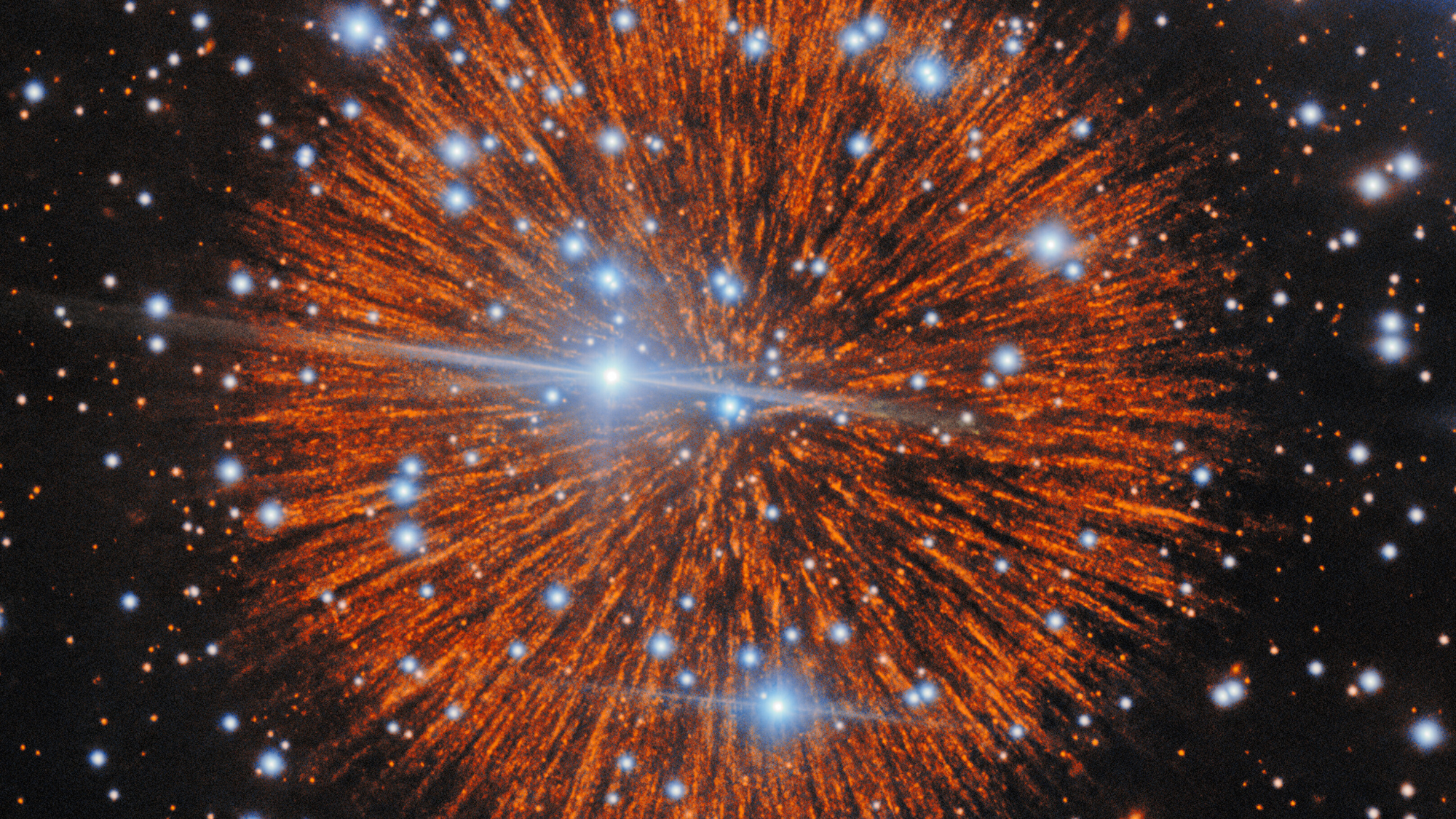
Astronomers have mapped pearl-like knots in Pa 30, a cloud of gas and debris left by a stellar explosion.
Pa 30 is about 7,500 light-years from Earth and is the Milky Way’s only observed remnant of this type.
Historical records from Japan, China and the Arab world describe an explosion in 1181 that scientists later linked to Pa 30.
The blast left a rare surviving star, known as a zombie star, at the remnant’s heart.
The star’s position suggests the explosion was roughly symmetrical and gave it only a small push.
The knots are each large enough to contain the orbit of Neptune many times over, and researchers say they want to model their uniform shapes.

Astronomers used the Gemini North telescope to make detailed observations of Pa 30, a supernova remnant with a rare “zombie star” at its center.
They found evenly spaced knots of gas along strands radiating from the explosion site.
The star sits almost exactly at the center of the remnant, suggesting the explosion was roughly symmetrical and gave it little movement.
Pa 30 is the only known Milky Way supernova remnant of its type and is about 7,500 light-years from Earth.
Historical records link the remnant to an explosion observed in 1181.
- Who
- A team including Ilaria Caiazzo, an assistant professor at the Institute of Science and Technology Austria.
- What
- Researchers made detailed observations of Pa 30 and found knots along its gas strands. They also measured an upper limit on the movement of its central zombie star.
- When
- The explosion was recorded in 1181. The observations’ date is Not stated.
- Where
- Pa 30, in the Milky Way, about 7,500 light-years from Earth.
- Why
- To study the supernova remnant, its debris and the surviving star at its center.
This story does not have two clearly opposing sides.
Historical records in Japanese, Chinese and Arabic accounts documented the explosion later linked to Pa 30.
A citizen scientist first identified Pa 30.
Space.com reported the detailed observations made with the Gemini North telescope.
- Distance from Earth
- About 7,500 light-years
- Historical explosion
- Recorded in 1181
- First identified
- 2013
- Telescope used
- Gemini North
- Central object
- A surviving “zombie star
- Remnant distinction
- The only supernova remnant of its type observed in the Milky Way
What people are saying
We can see this much detail because of Pa 30's proximity to Earth
The planetary region of our solar system could fit in each knot about ten times with room to spare
The knots are quite strikingly uniform. We are excited to try to model them.
We practically don't see the star moving away at all.