

Science & Tech · Space · 11 hrs ago
Euclid’s Search for Strong Gravitational Lenses Gets Off to a Strong Start
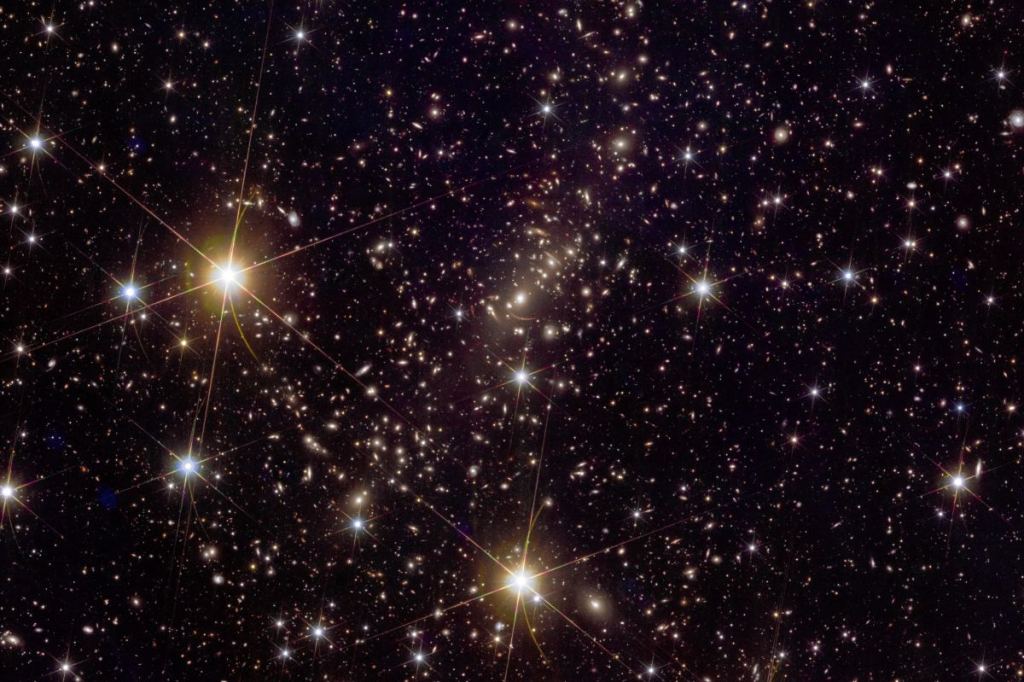
The European Space Agency’s Euclid space telescope is off to a strong start in its search for strong gravitational lenses.
Launched in 2023, Euclid is on a six-year mission to make a three-dimensional map of the sky.
Strong lenses are massive objects, such as galaxies and galaxy clusters, whose gravity can magnify light from objects behind them.
That effect can help researchers map dark matter, which does not interact with light and remains poorly understood.
Dark matter and dark energy shape the universe, but scientists do not know what either one is.
Euclid’s observations could help answer questions about their nature and the universe’s history.
The telescope will continue its mission from its position about 1.5 million kilometres from Earth.

Euclid’s search for strong gravitational lenses is described as getting off to a strong start.
The European Space Agency’s Euclid space telescope is on a six-year mission to create a 3D map of the sky.
Euclid launched in July 2023 and operates near the Sun-Earth Lagrange point 2, about 1.5 million kilometres from Earth.
The telescope uses a 600-megapixel camera and instruments that measure the redshift of distant sources.
Strong gravitational lenses can magnify background objects and help researchers map dark matter.
- Who
- The European Space Agency’s Euclid space telescope and the Euclid collaboration.
- What
- Euclid’s search for strong gravitational lenses is described as getting off to a strong start.
- When
- The article was published on November 19, 2026.
- Where
- Euclid operates near the Sun-Earth Lagrange point 2, about 1.5 million kilometres from Earth.
- Why
- Strong gravitational lenses can magnify otherwise hard-to-observe background objects and help map dark matter.
This story does not have two clearly opposing sides.
This story does not have a timeline yet.
- Mission length
- Six years
- Launch
- July 2023
- Operating location
- Sun-Earth Lagrange point 2, about 1.5 million kilometres from Earth
- Camera
- 600 megapixels
- Redshift reach
- About 10 billion sources out to redshift 2
What people are saying
Euclid’s data gives us the potential to answer those questions.