

Science & Tech · Science & Environment · 1 hr ago
Lumina simulation models the universe’s first two billion years
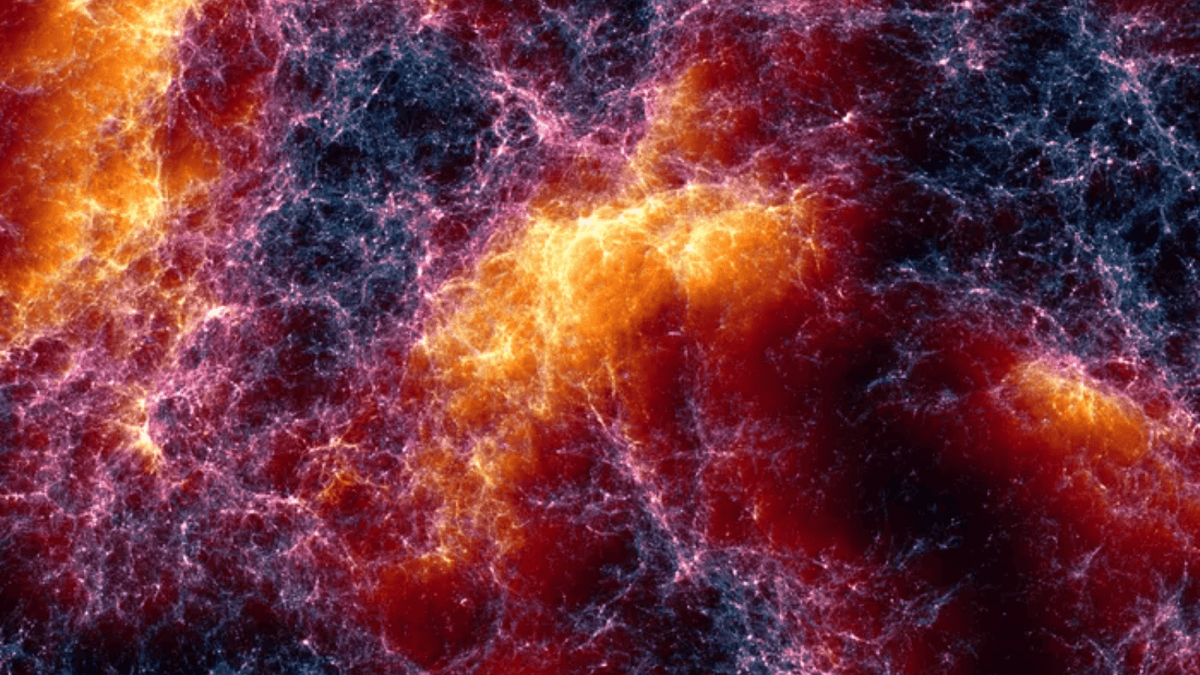
Scientists have created Lumina, a simulation of the universe’s first two billion years after the Big Bang.
Researchers at the Harvard-Smithsonian Center for Astrophysics developed the model to show how matter, dark matter and radiation interacted as the universe evolved.
It models a cube of space 1.5 billion light-years across, making it 100 times larger in volume than earlier simulations of this kind.
As the universe cooled, the first stars and galaxies formed and gave off radiation that changed hydrogen and helium atoms.
Lumina is the first simulation to model helium reionisation, when radiation strips electrons from helium atoms.
Scientists can use the model to study how these changes shaped the universe and compare their theories with telescope observations.

The Lumina simulation models how ordinary matter, dark matter and radiation interacted during the universe’s first 2 billion years.
Scientists at the Center for Astrophysics | Harvard & Smithsonian developed the model, described in a study published in Monthly Notices of the Royal Astronomical Society.
Lumina is the largest cosmological radiation-hydrodynamics simulation created, modelling a cube of space 1.5 billion light-years on each side.
The simulation lets scientists study helium reionisation and how early galaxies transformed the gas around them.
Researchers say comparisons between Lumina’s predictions and telescope observations can help test theories about the universe.
- Who
- Scientists at the Center for Astrophysics | Harvard & Smithsonian developed Lumina.
- What
- A simulation models interactions among matter, dark matter and radiation during the universe’s first 2 billion years.
- When
- The model covers the universe’s first 2 billion years; the study was published on 26 October 2026.
- Where
- Lumina models a cube of space 1.5 billion light-years on each side.
- Why
- It gives scientists a tool to study the early universe and test theories against observations from telescopes.
This story does not have two clearly opposing sides.
Lumina models interactions among matter, dark matter and radiation during this period.
The study detailing Lumina was published in Monthly Notices of the Royal Astronomical Society.
- Simulation
- Lumina
- Modelled period
- First 2 billion years after the Big Bang
- Volume
- Cube of space 1.5 billion light-years on each side
- Computing resources
- More than 15,000 graphics processing units
- Study journal
- Monthly Notices of the Royal Astronomical Society
2 sources
What people are saying
Popular Science | With JWST, the early universe has become an exciting new frontier in astrophysics
Popular Science | To understand what we are seeing with this telescope, we need to translate our theories into detailed predictions.
We feel incredibly fortunate to be building simulations like Lumina.