

Science & Tech · Science & Environment · 3 hrs ago
Researchers Use Ultrasound to Guide Liquid Through Mid-Air
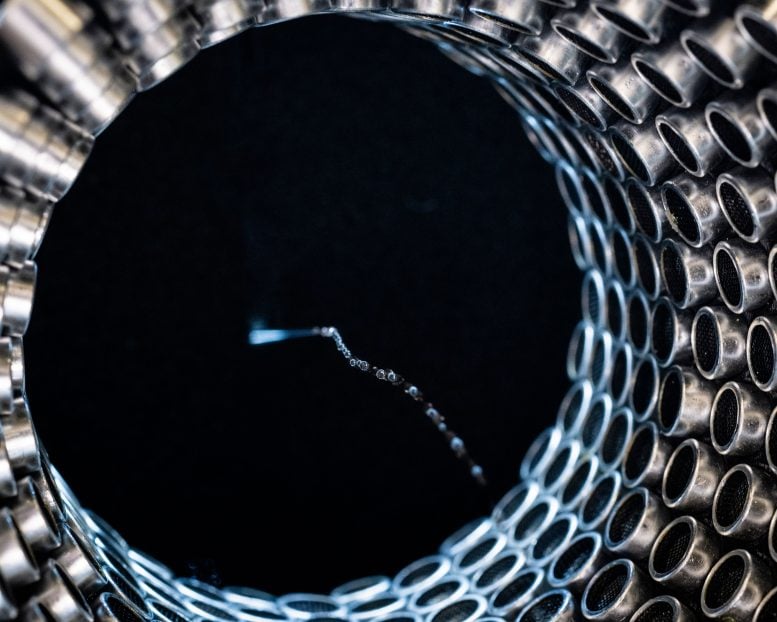
Researchers at the University of Helsinki created a wall-free tube that guides liquid through open air.
It uses 256 small speakers arranged around the liquid to produce ultrasound, which is too high-pitched for people to hear.
By coordinating the sound waves, the device confines the liquid to a narrow path without letting it touch a solid surface.
Researchers can electronically change the path and control the liquid’s release, including one drop at a time.
The approach could help move corrosive or contamination-sensitive substances without contact with conventional pipes.
The prototype makes a channel eight centimeters long and uses about 50 watts of electricity per section.
Researchers say multiple sections could be connected to make a longer channel.

Researchers at the University of Helsinki have created an invisible tube that guides liquid through open air using ultrasonic waves.
The system uses 256 miniature speakers to confine liquid to a narrow path without physical walls.
Researchers can electronically reshape the path, redirect the liquid and control its release with single-drop precision.
The prototype’s ultrasonic tube is eight centimeters long and each section uses about 50 watts of electricity.
The researchers say the approach could transport substances that are corrosive, sticky or sensitive to contamination without contact with pipe surfaces.
- Who
- Researchers at the University of Helsinki, led by Professor Ari Salmi, developed the device with collaborators at the Public University of Navarre and the University of Michigan.
- What
- They created an ultrasonic field that guides liquid through open air without physical pipe walls.
- When
- The prototype was developed after Salmi conceived the idea four years before the article was published on 2026-10-31.
- Where
- At the University of Helsinki, with collaborators at the Public University of Navarre and the University of Michigan.
- Why
- The technology could transport corrosive, sticky or contamination-sensitive substances without exposing them to conventional pipe surfaces.
This story does not have two clearly opposing sides.
Ari Salmi conceived the idea after earlier work on using ultrasound to clean pipe interiors.
Salmi realized ultrasound might form the walls of a pipe rather than clean them.
Researchers experimented with speaker coordination and developed the device with collaborators at the Public University of Navarre and the University of Michigan.
SciTechDaily published an article describing the prototype and its capabilities.
- Speakers
- 256 miniature speakers arranged in a cylinder around the liquid
- Frequency
- About 40 kilohertz
- Prototype length
- 8 centimeters
- Power use
- Approximately 50 watts per 8-centimeter section
- Speaker distance
- Approximately 5 centimeters from the flowing liquid
What people are saying
Of all the experimental setups I have seen, I would say this is the closest thing to magic
By changing how the speakers are controlled, we can reshape and turn the tube as needed
At the core of the device, the intensity of the ultrasound is comparable to a continuous roar of gunfire right next to your ear