

Science & Tech · Space · 3 hrs ago
Not all gaps in a young star’s disk are caused by planets
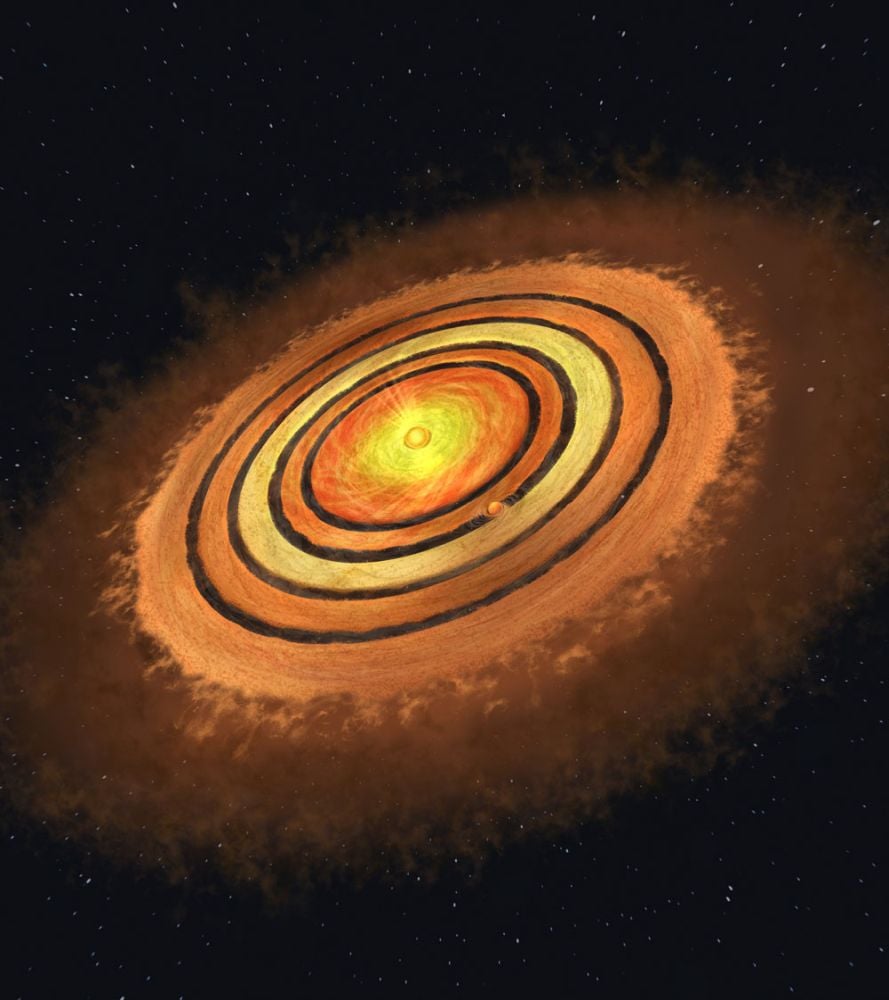
Astronomers found that planets may not explain every gap in the rings around young stars.
They studied V1094 Scorpii, a young star about 500 light-years away with a large disk of gas and dust where planets form.
The team used existing observations from the ALMA telescope and the SPHERE instrument on the Very Large Telescope to examine the disk.
Their analysis points to a mixed origin: a low-mass planet may have made some features, while a process called secular gravitational instability may have made others.
The disk has several ring-and-gap pairs, and explaining each one with a planet would require many planets to have formed already.
The findings could help astronomers better understand how planets form and interpret patterns in other young stars’ disks.
The study was published in The Astrophysical Journal; the supplied account does not say what researchers plan to do next.

Researchers studying the young star V1094 Scorpii found that not all gaps in its disk are explained by planets.
The team used existing ALMA images and observations from the Very Large Telescope’s SPHERE instrument.
The disk has four narrow dust ring-gap pairs extending to about 380 astronomical units.
The researchers’ study proposes a hybrid origin involving a low-mass planet and secular gravitational instability.
V1094 Scorpii is about 500 light-years away and has a large disk extending to about 300 astronomical units, according to the article.
- Who
- A team of Japanese astronomers led by Masayuki Yamaguchi.
- What
- The team studied ring-gap patterns in the disk around V1094 Scorpii and proposed that they have more than one cause.
- When
- The study was published on November 27, 2026.
- Where
- Around V1094 Scorpii, about 500 light-years away; the team analyzed ALMA and Very Large Telescope observations.
- Why
- To investigate whether planets explain all the rings and gaps in the young star’s disk.
Planet-driven explanation
Other processes
Cause of disk gaps
Planet-driven explanation
Young planets orbiting a star can carve gaps in its disk.
Other processes
Some gaps may be caused by other phenomena, including secular gravitational instability.
A paper first identified V1094 Scorpii as a giant protoplanetary disk with multiple rings and gaps.
Universe Today reported on the study of the disk’s ring-gap patterns.
- Star
- V1094 Scorpii
- Distance
- About 500 light-years
- Dust ring-gap pairs
- Four, extending to about 380 astronomical units
- Gas disk
- Traced to about 760 astronomical units
- Study’s proposed origins
- A low-mass planet and secular gravitational instability
What people are saying
These patterns aren’t new; what was a mystery was how these grooves were carved.
The most popular explanation is that young planets make these gaps as they orbit the star. However, when a disk has many rings, it becomes harder to explain since it’s hard to imagine that multiple planets have already formed.