

Science & Tech · Science & Environment · 2 hrs ago
Study Rules Out Stupendously Large Black Holes as Dark Matter
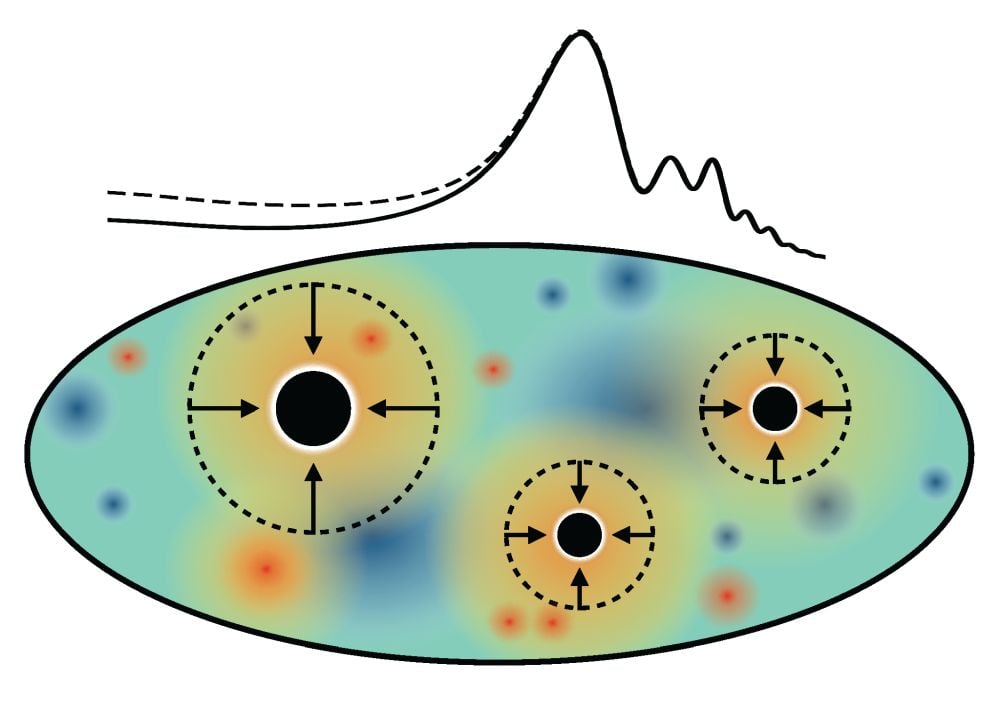
Researchers have ruled out stupendously large black holes as dark matter in a new study.
The work concerns primordial black holes, hypothetical objects thought to have formed soon after the Big Bang, and uses data from the European Space Agency’s Planck satellite.
Dark matter is an unidentified substance whose presence is inferred from its effects, and scientists are testing different possible explanations for it.
The cosmic microwave background is ancient light released when the universe was about 380,000 years old; researchers looked for patterns in it that these black holes would have left behind.
The study found no such evidence, closing off this black-hole candidate as an explanation for dark matter.
Researchers can still use Planck’s data to investigate the early universe, while the nature of dark matter remains unresolved.

A study says stupendously large black holes cannot account for dark matter.
The research, published in Physical Review Letters, examined data from the European Space Agency’s Planck satellite.
The study focused on whether these black holes would leave a detectable imprint in the cosmic microwave background.
Stupendously large black holes are theorized to have formed from matter overdensities shortly after the Big Bang.
Lead author Christopher Gerlach is a theoretical physicist at Johannes Gutenberg University in Mainz, Germany.
- Who
- Researchers led by Christopher Gerlach at Johannes Gutenberg University.
- What
- A study ruled out stupendously large black holes as an explanation for dark matter.
- When
- The article was published on November 13, 2026.
- Where
- The research used data from the European Space Agency’s Planck satellite. The study was published in Physical Review Letters.
- Why
- The researchers examined whether the black holes would leave a characteristic imprint in the cosmic microwave background.
This story does not have two clearly opposing sides.
The European Space Agency’s Planck satellite ended its mission.
Universe Today published an article about the study, which used Planck data.
- Study title
- Closing the Mass Window for Stupendously Large Black Holes
- Journal
- Physical Review Letters
- Lead author
- Christopher Gerlach
- Data source
- European Space Agency’s Planck satellite
- Maximum proposed mass
- 10 billion billion solar masses
1 source
What people are saying
A possible solution to the puzzle of dark matter was that it might have collected shortly after the Big Bang in giant black holes with masses ranging from 100 million to 10 billion billion times that of the sun,
That we are still generating new insights into the universe’s evolution and structure 13 years after it was shut down only emphasizes how important the Planck satellite was and is to physicists.
The early universe still has many puzzles waiting to be solved.
If these SLABs had existed in large numbers and contained significant amounts of dark matter, they would have left a characteristic imprint on the CMB through their unique perturbations, or, in a word, making it grainy