

Science & Tech · Science & Environment · 10 hrs ago
Researchers Find Sideways Magnetic Fields Can Affect Light in Optical Fibers
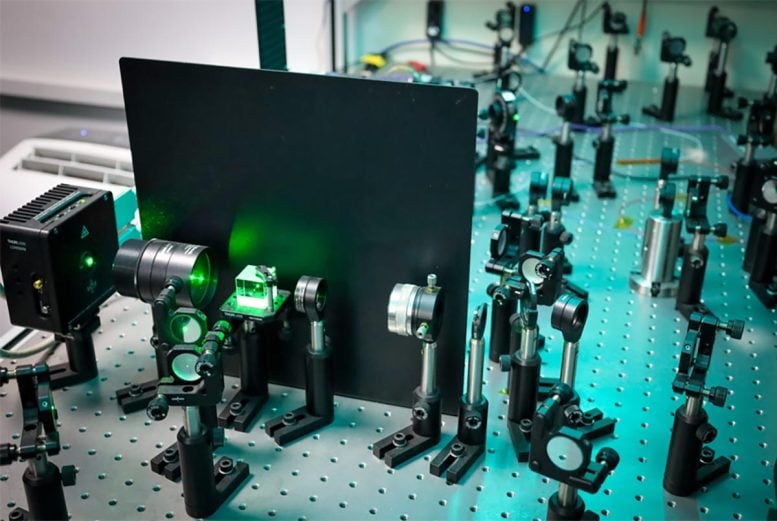
Researchers at Wits University in Johannesburg found that sideways magnetic fields affect light inside optical fibers.
Optical fibers are thin glass strands that carry internet signals and can also detect magnetic fields.
Existing fiber sensors generally rely on a magnetic field pointing along the direction light travels, and often need to wrap around a cable.
The newly observed transverse Faraday effect works with a field pointing across the fiber instead.
The researchers tested the effect by placing magnets beside a fiber and recording changes in the light pattern at its output.
The finding could allow sensors to sit alongside buried electrical cables and may also offer a way to control light for optical computing.
Researchers still need to overcome a major sensitivity challenge before the idea can be used in practical sensors.

Researchers at the University of the Witwatersrand in South Africa found that sideways magnetic fields can affect light traveling through optical fibers.
The effect, called the transverse Faraday effect, was observed by MSc student Mohammed Raiyan Sharif and Professor Mitchell Cox.
Their experiment used magnets placed beside a stationary multimode fiber and recorded changes in the pattern of light emerging from it.
The finding challenges an assumption used in fiber optics for more than 50 years.
It could eventually help develop magnetic-field sensors that sit alongside electrical cables and may offer a way to control light for optical computing.
- Who
- MSc student Mohammed Raiyan Sharif and Professor Mitchell Cox at the University of the Witwatersrand.
- What
- They demonstrated that a sideways magnetic field can affect light in an optical fiber.
- When
- The article was published on 2026-11-21; the experiment date is not stated.
- Where
- The Wits Optical Communication Lab in Johannesburg, South Africa.
- Why
- They investigated whether a sideways magnetic field could influence light in a fiber, an effect that could have future uses in sensing and optical computing.
This story does not have two clearly opposing sides.
Michael Faraday first observed the Faraday effect in glass.
An assumption that guided optical engineering began to be used, according to the article.
SciTechDaily published an article about the researchers’ finding.
- Researchers
- Mohammed Raiyan Sharif and Professor Mitchell Cox
- Institution
- University of the Witwatersrand, Johannesburg
- Effect
- Transverse Faraday effect
- Fiber type
- Step-index multimode optical fiber
- Publication
- Optics Letters
What people are saying
It wasn’t hard to 3D print a rig to test our intuition. Working out the theory for what we were seeing was the challenging part
The key was to return to the underlying equations and question assumptions that are usually taken for granted in fiber optics.